


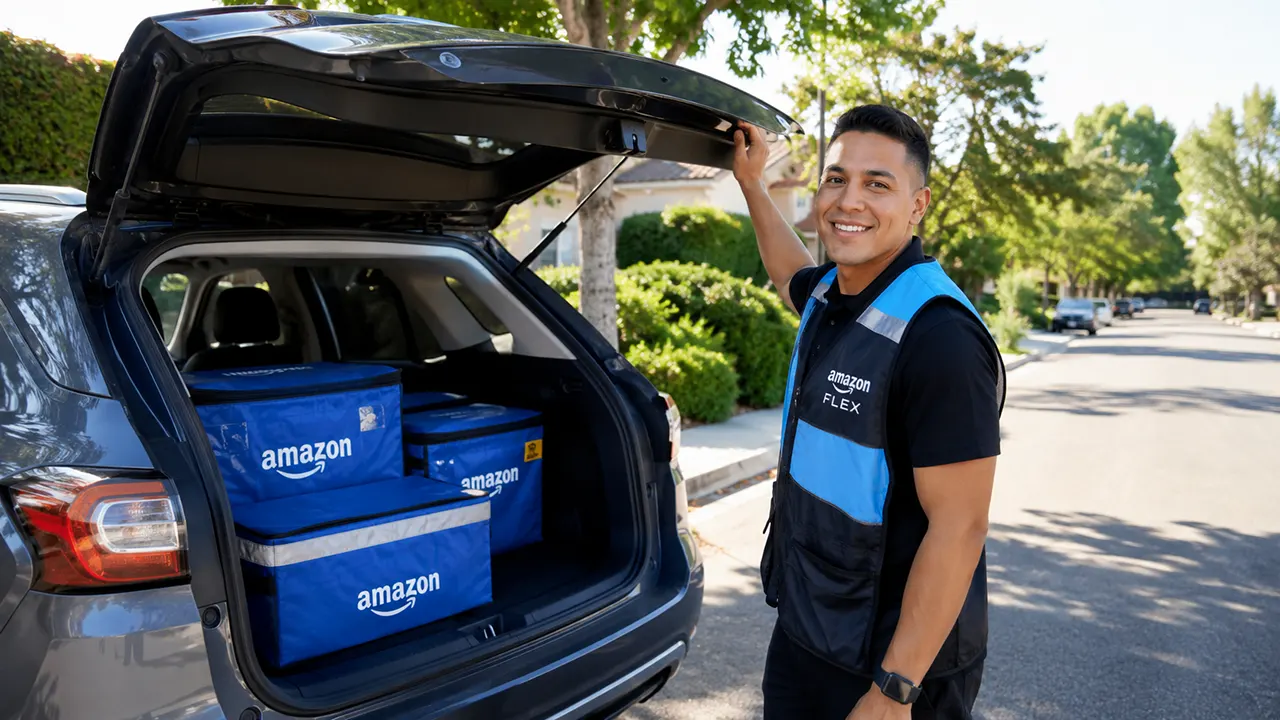
You want a side hustle that pays weekly and lets you set your own hours.
Amazon Flex promises exactly that, but the reality of grabbing delivery blocks and managing vehicle wear often catches new drivers off guard. Before downloading the Amazon Flex app, understand the exact requirements, the true hourly earnings after expenses, and how to secure the highest-paying blocks in your area.
Amazon Flex Driver Requirements
Amazon Flex requires drivers to meet specific age, vehicle, and documentation standards before hitting the road. These baseline rules ensure legal compliance and package security across the delivery network.
Age and Legal Documentation
You must be 21 years or older to deliver for Amazon Flex. A valid U.S. driver’s license and a Social Security number are mandatory for the background check process.
Vehicle Specifications
Your vehicle must be a 4-door sedan, SUV, van, or truck with a covered bed. 2-door coupes and open-bed pickup trucks fail the vehicle requirement check. The vehicle must be insured to meet local state requirements.
Amazon provides a commercial auto insurance policy at no cost to you while actively delivering, but your personal insurance must allow gig work. If your personal insurer excludes delivery driving, you face a coverage gap during off-block hours.
Smartphone Compatibility
The Amazon Flex app runs only on compatible smartphones. For Android, you need OS version 8.1 or higher with at least 2GB of RAM. For iPhone, iOS 15.0 or higher is required. A phone with a reliable GPS and a solid data plan prevents mid-route navigation failures.
How to Apply for Amazon Flex Driver Status
The application process is entirely digital through the Amazon Flex app. Approval times vary, but completing every step accurately accelerates your onboarding timeline.
Download the Amazon Flex app for Android or iPhone directly from the official app stores. Avoid third-party APKs to prevent account bans.
Create an account using your email or existing Amazon login. Enter your legal name, address, and Social Security number for identity verification.
Upload clear photos of your driver’s license and a selfie. Fuzzy images trigger manual review delays, so ensure bright, glare-free lighting.
Consent to the background check. This checks motor vehicle records and criminal history. Approval usually takes 2 to 5 business days.
Select your preferred delivery station and watch the mandatory onboarding videos within the app. You are now eligible to claim blocks.
💡 Key Takeaway: If your area shows no open positions, join the Amazon Flex interest list. Openings appear frequently as current drivers churn out of the system.
How Much Do Amazon Flex Drivers Really Make?
Amazon advertises $18 to $25 per hour, but your actual take-home pay depends entirely on your location, tips, and vehicle efficiency. Understanding the difference between gross pay and net pay prevents financial surprises at tax time.
Average NET hourly pay after gas, maintenance, and taxes
Block Pay and Tips
You see the exact payout for a delivery block before accepting it. A standard 3-hour block typically pays $54 to $75. Amazon Fresh and Whole Foods blocks often yield higher tips, pushing effective hourly rates beyond the base $18-$25 range.
The Expense Reality
Amazon Flex drivers are independent contractors, not employees. You pay for your own fuel, oil changes, tire rotations, and depreciation. The IRS standard mileage rate sits at 67 cents per mile for 2024. Driving 100 miles during a shift costs you $67 in vehicle expenses alone.
Set aside 25-30% of your Amazon Flex earnings for quarterly estimated taxes. Since Amazon does not withhold taxes, failing to save this portion leads to massive tax bills and penalties in April.
Let’s be honest: earning $1000 a week with Amazon Flex requires driving 40+ hours and maximizing every surge block, but your vehicle will take a brutal beating in the process.
Getting Paid
Amazon issues direct deposits every Tuesday and Friday. If you need cash immediately, use the Amazon Flex Instant Pay feature to cash out earnings for a small fee, or use the Amazon Flex Debit Card for fee-free transfers.
Surviving the Block Grab
Securing delivery blocks presents the biggest challenge for new Amazon Flex drivers. High-paying shifts vanish in seconds, forcing drivers to develop fast reflexes and strategic scheduling habits.
Understanding Block Types
Delivery blocks range from 2 to 6 hours. Logistics blocks deliver standard Amazon packages from delivery stations. Sub-Same Day blocks handle urgent, smaller parcels. Store orders involve picking up from Whole Foods or Amazon Fresh. Store orders generally offer higher tip potential.
Strategies to Get Blocks
Blocks drop at specific times, usually midnight or early morning depending on your station. Keep the Amazon Flex app open and tap the refresh button right as the clock strikes the drop time. “Instant offers” appear throughout the day when other drivers cancel, providing excellent last-minute opportunities.
Build your standing to “Fantastic” to unlock Preferred Scheduling. This feature lets you reserve blocks a week in advance, completely eliminating the stressful block-grabbing scramble.
Delivery Day Execution
Executing a delivery block efficiently dictates your true hourly rate. Wasted minutes at the warehouse or searching for apartment complexes quickly erode your earnings.
At the Warehouse
Arrive at the delivery station 10 minutes before your block starts. Scan your packages using the Amazon Flex app and load them into your vehicle organzied by stop number. A 3-hour block typically contains 30 to 50 packages.
On the Road
Follow the app’s optimized route. Use a reliable phone mount and keep your screen bright. The best grabber for Amazon Flex is a long-reach magnetic tool, saving your back from repetitive bending when placing packages on porches.
Handling Undeliverable Packages
If a customer is unavailable or a location is unsafe, mark the package as undeliverable in the app. Return undeliverable packages to the station at the end of your block. Failing to return them damages your delivery standing.
Amazon Flex Driver Benefits and Rewards
Independent contractors do not receive traditional health insurance or paid time off. However, Amazon Flex offers a specialized rewards program and partnered perks to offset costs.
Amazon Flex Rewards
Drivers earn points for every completed block. Accumulating points unlocks tiers that provide cash back on gas and vehicle maintenance. The top tier grants access to Preferred Scheduling, ensuring you always get the blocks you want.
Health and Tax Resources
Amazon partners with Stride Health to offer independent contractors access to discounted health insurance plans and tax deduction tracking. While Amazon does not pay for these plans, the partnership simplifies finding coverage.
You can absolutely write off your gas and mileage as an Amazon Flex driver, but you must choose between the standard IRS mileage rate OR actual expenses—you cannot claim both.
Is Amazon Flex Worth It?
Amazon Flex serves as an excellent side hustle for those who need schedule flexibility and own a reliable, fuel-efficient vehicle. It falls short as a full-time replacement for a traditional W-2 job due to the lack of benefits and the heavy vehicle depreciation.
BEST FOR SIDE HUSTLERS
If you want to knock out a few 3-hour blocks on weekends to cover rent or pay off holiday debt, Amazon Flex provides immediate, predictable payouts.
WORST FOR FULL-TIME
Relying solely on Amazon Flex for 40+ hours a week accelerates vehicle wear and leaves you exposed without health insurance, paid sick leave, or workers’ comp.
Your First Delivery Awaits
Download the Amazon Flex app, verify your documents, and grab your first block. Treat your driving like a business by tracking every mile and saving receipts for gas. The road to extra income starts the moment you hit accept.
Amazon Flex Driver FAQ
Can you make $1000 a week with Amazon Flex?
Making $1000 a week requires working 40 to 50 hours and consistently securing high-paying surge blocks. It is physically demanding and heavily increases vehicle wear, making it difficult to sustain long-term.
Can you make $500 a week with Amazon Flex?
Earning $500 a week is highly achievable. You need to complete roughly 20 to 25 delivery hours, which equates to about six 3-hour blocks or four 5-hour blocks spread across the week.
How many packages are in a 3 hour block on Amazon Flex?
A standard 3-hour logistics block contains 30 to 50 packages. Store orders from Amazon Fresh or Whole Foods typically involve fewer, heavier packages or bags.
How much do Amazon Flex drivers really make?
Gross pay ranges from $18 to $25 per hour. After subtracting gas, maintenance, and self-employment taxes, true net earnings average between $13 and $17 per hour.
Do Amazon Flex pay for fuel?
No, Amazon Flex does not pay for fuel. Drivers are independent contractors responsible for all vehicle expenses, including gas, oil changes, and insurance.
How much does Amazon Flex pay for a 3 hour block?
A 3-hour block typically pays between $54 and $75 base pay, plus any customer tips. Surge pricing during peak seasons can push this rate higher.
How much can you make in 4 hours with Amazon Flex?
In a 4-hour block, you can expect to earn $72 to $100 in base pay, plus tips. Whole Foods deliveries often yield higher tips, pushing 4-hour earnings over $120.
What is the best grabber for Amazon Flex?
The best grabber for Amazon Flex is a lightweight, aluminum reacher tool with a magnetic tip and a rotating claw, typically 32 to 40 inches long. It saves your back from constant bending when placing packages on porches.
Is it worth it to use Amazon Flex?
Amazon Flex is worth it if you need flexible side income and own a fuel-efficient vehicle. It is not worth it if you drive a gas-guzzling truck or need a guaranteed full-time income with benefits.
Can I do 2 blocks a day on Amazon Flex?
Yes, you can do 2 blocks a day provided the times do not overlap. Many drivers stack a morning block and an evening block to maximize daily earnings.
Can I write off my gas for Amazon Flex?
Yes, you can write off gas using the actual expense method, or you can deduct mileage using the standard IRS mileage rate. Consult a tax professional to determine which method saves you more money.
Who pays more, FedEx or Amazon?
FedEx Ground contractors often pay slightly more per hour than Amazon Flex, but FedEx routes require heavier lifting and longer, more rigid shifts. Amazon Flex offers greater schedule flexibility.
Is Amazon Flex hard to get into?
Getting into Amazon Flex is not hard if you pass the background check and live in an area with open positions. The main barrier is the waitlist in saturated cities.
What is the highest paying delivery app?
Amazon Flex generally pays the highest base hourly rate among gig delivery apps, but Uber Eats and DoorDash offer higher tip potential in dense urban areas during peak meal hours.
What is the best time to do Amazon Flex?
The best times to do Amazon Flex are early mornings (7 AM to 10 AM) and evenings (5 PM to 9 PM) when delivery demand peaks. Weekend blocks also offer consistent surge pay.

Belayet Hossain is a Senior Tech Expert and Certified AI Marketing Strategist. Holding an MSc in CSE (Russia) and over a decade of experience since 2011, he combines traditional systems engineering with modern AI insights. Specializing in Vibe Coding and Intelligent Marketing, Belayet provides forward-thinking analysis on software, digital trends, and SEO, helping readers navigate the rapidly evolving digital landscape. Connect with Belayet Hossain on Facebook, Twitter, Linkedin or read my complete biography.