


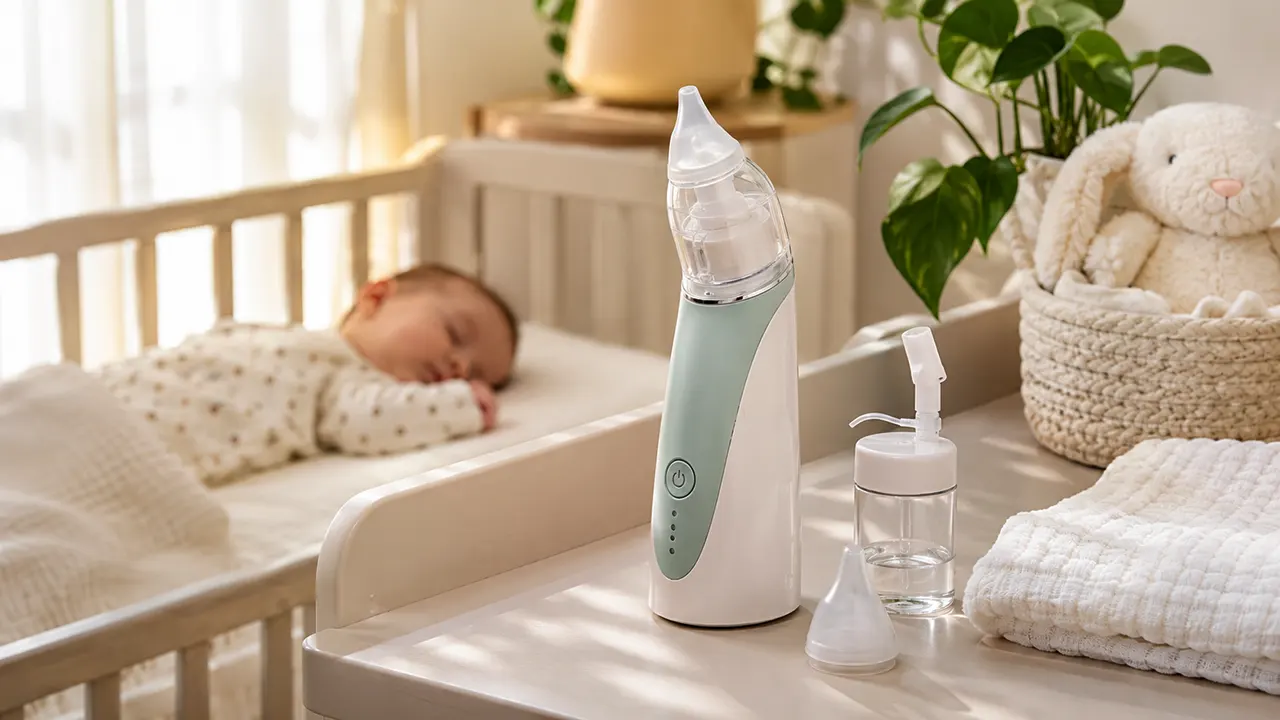
A blocked nose turns a baby’s night upside down, and the whole house usually feels it by morning. Until roughly four to six months old, infants breathe almost entirely through their noses, so even a little dried mucus or dust can make feeding and sleep a struggle. They can’t blow their own noses either, which leaves the job to tired parents at two in the morning. That’s where clever engineering has quietly stepped in. Choosing the best infant nasal aspirator now comes down to technology as much as comfort, with motors, pumps and mist nozzles doing work that a squeezed rubber bulb once did by hand.
The newest designs go a step further by combining two jobs in one handheld device. A 2-in-1 spray suction electric nasal aspirator first releases a fine saline mist to soften dried crusts, then switches to gentle electric suction to draw the loosened mucus away through a soft silicone tip. It sounds simple. Behind the casing, though, sits a surprising amount of thoughtful engineering, and it explains why these gadgets have become such a common sight in modern nurseries.
Why Baby Nasal Care Became an Engineering Problem
Tiny noses leave very little room for error. A newborn’s nasal passages are extremely narrow, so slight swelling or one tiny crust can cut airflow noticeably. The lining inside is also delicate and packed with tiny blood vessels, which react quickly to dry air, draughts, dust and common colds. A baby who keeps pulling away from a bottle to catch a breath is often showing exactly this problem.
Those conditions set a clear design brief. Any tool has to be gentle, predictable and easy to keep clean. Suction that’s too strong can irritate the lining, while suction that’s too weak achieves nothing. Getting that balance right is precisely the kind of challenge engineers enjoy. A setting that feels mild against an adult’s hand may still be too strong for a newborn.
From Rubber Bulbs to Electric Motors
Manual tools have done the job for generations, but they have clear limits. A rubber bulb syringe relies on a parent’s grip to create a vacuum, so the pressure changes every single time. Squeeze hard and it can pull too firmly. Squeeze softly and very little happens.
Hygiene is another weak spot. The dark, sealed inside of a bulb is almost impossible to dry or check properly, and mould can build up unseen over months. Many have rigid plastic tips as well, which feel uncomfortable when a baby wriggles at the wrong moment.
Mouth-operated suction tubes improved control by letting parents draw air through a filter with their own breath. They work, but they need two hands and steady coordination, which isn’t easy with a squirming infant on one knee. Most parents only need one try to see the problem. A baby who suddenly turns their head can undo the whole effort in a second.
Electric aspirators replace guesswork with a small motor that produces steady, repeatable suction. That consistency is the big leap forward. The same setting delivers the same pull every time, whether it’s the first use of the day or the tenth.
How the Suction System Works
At the heart of an electric aspirator sits a compact motor driving a small vacuum pump. When the motor runs, it lowers the air pressure inside the device’s chamber. Air and mucus near the tip then move towards that lower pressure, much like a drink travelling up a straw. The principle is centuries old. The precision is what’s new. A steady motor builds suction smoothly instead of starting with a sharp jolt.
Most models offer several suction levels. Lower settings suit thin, runny mucus, while higher ones help with thicker secretions, all kept within limits designed with infants in mind. A parent dealing with a mild sniffle can stay on the gentlest setting and leave it there.
The tip forms only a light seal at the entrance of the nostril, so the device never needs to go deep inside. Soft, food-grade silicone tips flex on contact, cushioning any sudden movement. A clear collection chamber sits between the tip and the pump, catching the mucus before it can reach the motor and letting parents see at a glance how much has been cleared.
How the Saline Spray Function Works
Suction on its own struggles with hardened mucus. Pulling at dry crusts can irritate the delicate lining and rarely clears much anyway. That’s why the spray stage matters so much.
In a 2-in-1 device, a separate mist system draws sterile saline from a small reservoir and pushes it out as a fine spray. The spray spreads moisture across a wider area than a single drop, helping to soften crusts and thin sticky secretions. After a short wait, usually around 30 to 60 seconds, the mucus becomes far easier to lift away. Patience at this stage makes the next one much quicker.
Switching between spray and suction typically takes the press of a button rather than a change of tool. That matters more than it might seem. Fewer fiddly swaps mean less time holding a fussing baby still. A reservoir that refills quickly also means a fresh dose of saline is ready for the second nostril.
Design Features That Make the Technology Work
Good engineering only helps if the device is easy to live with. Several design choices make a real difference in daily use.
Rechargeable batteries remove the need for spare cells and keep the device ready for night-time use. Quiet motors matter too, since a loud buzz close to the ear can upset a baby before the job even starts. A device that hums softly is far more likely to be tolerated.
Detachable parts make cleaning straightforward. Tips, seal rings and collection cups usually come apart quickly, so each piece can be washed separately. A transparent chamber also shows when the device needs emptying.
Ergonomics deserves a mention as well. A shape that fits comfortably in one hand leaves the other free to support the baby’s head. Simple controls with clear settings help, especially when the lights are dim and patience is wearing thin. Buttons that can be found by touch alone are a small blessing during a 3 a.m. clean-up.
Using the Technology Safely
Even the smartest device depends on careful handling. The usual routine starts with softening the mucus using one or two drops of sterile paediatric saline, or the device’s built-in mist, then waiting 30 to 60 seconds. Dry suction is best avoided altogether.
Positioning comes next. Holding the baby semi-upright on a lap, with the head and neck supported, stops loosened fluid trickling back towards the throat. That small adjustment cuts down on coughing and gagging.
Suction works best on the lowest setting first. The silicone tip rests gently at the entrance of the nostril, never pushed deep inside, and angles a little towards the cheek, away from the central septum. Short bursts of two to three seconds are usually enough. A quick wipe with a soft, damp cloth and a cuddle or feed afterwards help the baby settle again.
Cleaning and Maintenance
Hygiene is built into a good design, but it still needs a regular routine. Because the parts touch nasal fluids, cleaning after every use is essential.
The removable parts come apart, get a rinse under warm running water and then a wash with mild, baby-safe soap. Each piece then dries fully on a clean rack before going back together. Packing damp parts away in a closed box invites mould.
During cold seasons, the silicone tips and plastic chambers, where heat-safe, can be sterilised in boiling water for three to five minutes once or twice a week. The electronic body must stay dry, so the outer casing only needs a wipe with a lightly dampened antibacterial cloth. A few minutes of care keeps the device working well for years.
Supporting the Technology with a Healthy Nursery
Devices work best alongside a comfortable room. Dry air draws moisture out of the nose’s lining, and the body responds by making extra mucus. A cool-mist humidifier keeping relative humidity between 40% and 50% helps keep nasal linings naturally moist overnight.
Cleaner air helps too. Regular vacuuming with a HEPA-filtered machine reduces dust and pet dander, while keeping pets out of the baby’s sleeping area and avoiding scented candles, aerosol sprays or harsh chemicals nearby all make a difference. Regular breast milk or formula feeds also keep the baby hydrated, which naturally thins mucus.
When Technology Isn’t Enough
Most stuffy noses clear up with simple home care. Some signs, however, need a paediatrician’s attention straight away. These include unusually fast breathing, flaring nostrils, skin pulling in between the ribs, a high or lasting fever, trouble feeding, unusual drowsiness, far fewer wet nappies or congestion that hasn’t improved after 10 to 14 days. No gadget replaces a proper medical check.
Conclusion: 2-in-1 Nasal Aspirators
The 2-in-1 nasal aspirator shows how thoughtful engineering can make a small but stressful parenting task far easier. A saline mist softens the blockage, a quiet motor provides steady and adjustable suction, and soft silicone tips keep the process gentle. Rechargeable power, washable parts and simple controls make the device practical for everyday use. Paired with careful technique, regular cleaning and a well-kept nursery, the technology helps babies breathe and sleep more comfortably. The motor can clear the nose. Only a calm pair of hands can make the baby feel safe while it does.
Want to explore more ways technology is making everyday health and personal care easier? Visit our Health Tech & Personal Care section for practical guides, product insights, and the latest innovations in personal health technology.

Belayet Hossain is a Senior Tech Expert and Certified AI Marketing Strategist. Holding an MSc in CSE (Russia) and over a decade of experience since 2011, he combines traditional systems engineering with modern AI insights. Specializing in Vibe Coding and Intelligent Marketing, Belayet provides forward-thinking analysis on software, digital trends, and SEO, helping readers navigate the rapidly evolving digital landscape. Connect with Belayet Hossain on Facebook, Twitter, Linkedin or read my complete biography.