


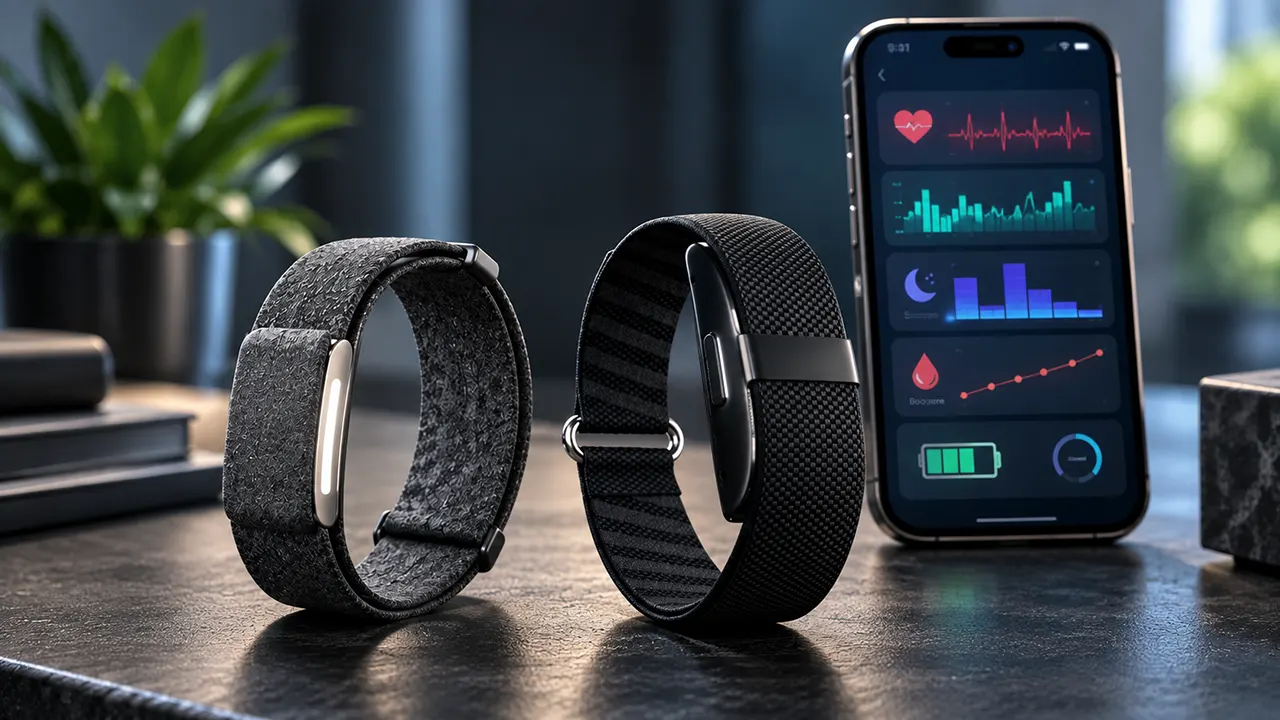
The Hume Band 2.0 adds blood-pressure trend insights, a redesigned UltraLux strap, longer advertised battery life, and updated signal processing compared with the original Hume Band. The two generations remain closely related, including the same 5-LED and 4-photodiode optical sensor configuration according to Hume’s current technical explanation.
If you already own the original Hume Band, the upgrade case depends mainly on whether the newer battery, blood-pressure trend feature, comfort changes, and software improvements matter to you.
Hume Band 1.0 vs 2.0: Quick Comparison
| Feature | Hume Band 1.0 | Hume Band 2.0 |
|---|---|---|
| Generation | Original | Second generation |
| Optical sensors | 5 LEDs + 4 photodiodes | 5 LEDs + 4 photodiodes |
| Signal processing | Original processing | Updated signal processing |
| Battery | Up to about 5 days according to original brand claims | Up to 14 days advertised |
| Blood-pressure trends | Not available | Available as trend insights |
| Strap | Original SuperKnit design | UltraLux / updated SuperKnit design |
| Sleep tracking | Yes | Yes |
| HRV | Yes | Yes |
| SpO2 | Yes | Yes |
| Recovery | Yes | Yes |
| Hume Health app | Yes | Yes |
| Screen | No | No |
| Water resistance | IP68 | IP68 |
| Premium option | Available | Available |
| Current availability | Discontinued | Current model |
Hume’s current product information identifies 5 LEDs and 4 photodiodes in Band 2.0 and lists up to 14 days of battery life. Wareable’s hands-on review of the original reported around four days in testing, compared with the original manufacturer’s claim of up to five days.
What Changed in Hume Band 2.0?
Hume describes four major differences between the generations: improved accuracy through signal processing, blood-pressure trend tracking, up to 14-day battery life, and a more premium UltraLux strap. Nutrition tracking is also listed as an upcoming feature.
Battery life
Battery life is one of the clearest changes on paper.
Hume advertises up to 14 days for Band 2.0, compared with an original Band claim of up to about five days. An independent Wareable review of the original Hume Band recorded about four days during testing.
That difference matters because a screenless health tracker is designed to remain on your body around the clock. More time between charges can reduce interruptions to overnight sleep tracking and longer-term trend collection.
However, “up to 14 days” is a maximum claim, not a guarantee that every user will get 14 days under every usage pattern.
Blood-pressure trend tracking
Blood-pressure trend insights are a new Band 2.0 feature.
Hume describes the feature as using PPG signals to identify changes in blood-pressure patterns over time. The company specifically says these are trend insights, not a cuff replacement or medical device.
That distinction matters.
The feature is designed to show changes in patterns rather than provide the same type of measurement as a traditional blood-pressure cuff. It should therefore be understood as an additional wellness signal rather than a substitute for clinical blood-pressure measurement.
Strap and comfort
Hume says Band 2.0 uses an updated UltraLux strap and describes the newer SuperKnit bands as designed for continuous wear.
Wareable’s 2026 review found the newer band comfortable for 24/7 wear but also noted that the overall feeling was not dramatically different from the first-generation band.
This is a good example of an upgrade that may matter more to a particular user than to another. If the original strap already works well for you, the practical difference may be smaller.
Signal processing and accuracy claims
Hume says Band 2.0 uses better signal processing to provide more reliable health insights and clearer trends over time.
But this needs careful interpretation.
Improved processing does not automatically mean that every metric is independently proven to be more accurate. Wareable’s review found that some heart-rate, sleep, and recovery inaccuracies could still occur during its testing.
So the safest conclusion is that Hume claims improved accuracy, while independent evidence does not establish that every measurement is consistently more accurate.
Nutrition tracking
Hume currently lists nutrition tracking as an upcoming feature rather than treating it as a fully established current capability.
That means prospective buyers should distinguish between:
- Features available now
- Features announced for a future update
An announced feature should not be the main reason to buy a product unless it has actually launched and meets your needs.
Did Hume Band 2.0 Get Better Sensors?
This is one of the most interesting parts of the comparison because the available information needs careful reading.
Hume’s current technical explanation says the Band 2.0 uses 5 LEDs and 4 photodiodes. More importantly, Hume’s own detailed explanation says the 2.0 uses the same 5-LED, 4-photodiode sensor block as the original, with improvements occurring in the processing that interprets the optical signal.
That is an important distinction.
What Hume says
Hume attributes the improvement to better signal processing and says the optical system provides frequent data capture. Its current product page describes the 5 LEDs and 4 photodiodes as the sensor configuration used by Band 2.0.
What independent sources report
Some recent comparison content has also identified the same 5-LED and 4-photodiode configuration across generations and attributes the main change to signal processing rather than a completely new optical sensor array.
Wareable’s review, however, describes the 2.0 as having new sensors while still identifying the same 5-LED and 4-photodiode configuration and reporting that measurement inaccuracies remained in testing.
What this means for buyers
The more precise way to describe the upgrade is not simply “new sensors.”
The stronger evidence points to a combination of the existing optical sensor configuration with updated processing and a new set of software-driven insights, including blood-pressure trends. Hume itself now explicitly explains the sensor block as shared between generations.
That makes the 2.0 more of a system-level refinement than a complete sensor-platform replacement.
Hume Band 2.0 vs Hume Band: Battery Reality
Battery life is one area where the generational difference is easy to understand, but the numbers still need context.
Hume currently advertises up to 14 days for Band 2.0. Its product page says charging typically takes 20 to 80 minutes depending on the battery level.
For the original Band, Wareable reported a brand claim of up to five days and recorded about four days during its own testing.
The practical advantage is therefore not just a larger battery number. It is the ability to leave the device on for longer periods with fewer charging interruptions.
For users who care about continuous sleep and recovery trends, that can be more meaningful than it sounds.
How Accuracy Compares Between the Two Generations
Accuracy is harder to compare than battery life because different metrics behave differently.
Hume says Band 2.0’s improved signal processing provides more reliable health insights and clearer trends.
But independent testing does not support a blanket statement that every metric is now highly accurate.
Wareable’s 2026 review reported continuing inaccuracies involving heart rate, sleep, and recovery measurements.
Heart rate and HRV
The optical sensor system provides the underlying signals used for metrics such as heart rate and HRV. Hume says the updated processing improves the reliability of the resulting insights.
However, the available independent evidence does not justify saying that Band 2.0 universally outperforms the original on every heart-rate or HRV measurement.
Sleep
Both generations are designed to provide sleep-related metrics, including sleep stages and sleep quality information. Hume lists light, deep, REM, and awake stages among the metrics tracked by Band 2.0.
Wareable’s testing indicates that sleep measurement can still have inaccuracies on the newer model.
So Band 2.0 should be viewed as a wellness-tracking device rather than a clinical sleep diagnostic system.
Recovery
Recovery is central to Hume’s product strategy. Band 2.0 continues to combine signals such as HRV, sleep, activity and other measurements into broader recovery-oriented insights.
The important distinction is that the underlying measurements and the interpretation layer are not the same thing. An algorithmic recovery score is an interpretation of collected signals, not a direct physical measurement.
Blood-pressure insights
Blood-pressure trends are the major new metric in this generation.
Hume says Band 2.0 uses PPG-based patterns to show how blood-pressure trends may shift over time, while explicitly warning that the feature is not a cuff replacement or medical device.
That makes this feature potentially useful for trend awareness, but it should not be treated as equivalent to a clinical blood-pressure measurement.
What Stayed the Same?
The upgrade is meaningful, but Band 2.0 is not a completely different category of wearable.
Both generations share the screenless form factor and the Hume Health ecosystem. The core tracking philosophy remains centered on health and wellness signals rather than turning the band into a conventional smartwatch.
Hume’s current documentation lists metrics including HRV, blood oxygen, sleep stages, activity, strain, recovery and skin temperature for Band 2.0.
The optical sensor configuration is also especially important: Hume’s current technical explanation states that the 2.0 uses the same 5-LED, 4-photodiode sensor block as the original.
So if you already like the original Hume experience, the 2.0 is better understood as an evolution of that platform rather than a completely new wearable concept.
Which Hume Band Should a New Buyer Choose?
For someone choosing between the two generations today, availability is an important factor.
The original Hume Band has been discontinued, while Hume has replaced it with Band 2.0. Wareable currently describes the original as discontinued and the 2.0 as its replacement.
Hume’s current official product page lists Band 2.0 at $249 at the time of research, reduced from a displayed $356 price, with a 45-day at-home trial.
That means a new buyer should not automatically interpret the original’s lower secondhand or remaining-stock price as equivalent value. Condition, warranty, availability and access to current features also matter.
If you are buying new, the decision is therefore mostly about whether the current Band 2.0 feature set fits your needs rather than choosing between two equally current products.
Should Existing Hume Band Owners Upgrade to 2.0?
For existing owners, the decision is more nuanced.
An upgrade may make more sense if you value:
- Longer advertised battery life
- Blood-pressure trend insights
- The updated strap design
- Newer software and ongoing product development
- The current-generation Hume experience
The battery difference is particularly relevant for people who wear the band continuously and dislike frequent charging. Hume currently advertises up to 14 days for Band 2.0.
Keeping the original may make more sense if:
- Your current band meets your tracking needs
- Battery life is not a major problem
- You do not need blood-pressure trend insights
- You are satisfied with the existing Hume Health experience
- You are primarily expecting a dramatic jump in raw sensor hardware
That last point deserves emphasis.
The 2.0 does not represent a wholesale replacement of the optical sensor block. Hume’s current technical explanation says both generations use the same 5-LED, 4-photodiode sensor block.
The more meaningful improvements are therefore in processing, battery, comfort and additional insights, rather than a radically different optical sensing platform.
Hume Band 2.0 vs Hume Band: The Bottom Line
The Hume Band 2.0 is an evolution of the original rather than a completely new wearable. Its clearest differences are the advertised 14-day battery, blood-pressure trend insights, updated strap and improved signal processing. Hume also confirms that the underlying optical sensor block remains the same 5-LED, 4-photodiode configuration.
For a new buyer, Band 2.0 is the relevant current-generation product. For an existing Hume Band owner, the upgrade decision depends on whether the newer battery, comfort and additional insights solve a real limitation with the original.
The most important point is to avoid treating “2.0” as shorthand for a completely new sensor platform. The evidence supports a more measured description: the same core optical architecture with changes in processing, software, battery and product design.
Frequently Asked Questions
Is Hume Band 2.0 better than the original Hume Band?
Band 2.0 adds several features and improvements, including up to 14-day advertised battery life, blood-pressure trend insights, an updated strap and improved signal processing. Whether those changes matter enough to upgrade depends on what you need from the original band.
What is the biggest difference between Hume Band 1.0 and 2.0?
The most visible differences are the longer advertised battery life, new blood-pressure trend insights and updated strap. Hume also says the newer model benefits from improved signal processing.
Does Hume Band 2.0 have better sensors?
Hume’s current technical explanation says Band 2.0 uses the same 5-LED, 4-photodiode sensor block as the original. The company attributes improvements primarily to processing that cleans and interprets the signals.
Is Hume Band 2.0 more accurate?
Hume claims improved accuracy through better signal processing, but independent testing has still identified inaccuracies in areas such as heart rate, sleep and recovery. The available evidence does not support treating every metric as definitively more accurate.
How long does Hume Band 2.0 last?
Hume currently advertises up to 14 days on a single charge. Actual battery life can vary according to usage and other conditions, so the 14-day figure should be treated as a maximum claim rather than a universal result.
Can the original Hume Band track blood-pressure trends?
The blood-pressure trend feature is identified by Hume as a new Band 2.0 capability. Hume describes it as trend insight rather than a cuff reading or medical-device measurement.
Is Hume Band 2.0 worth upgrading to?
There is no single answer for every owner. The upgrade has more practical significance if you want the longer advertised battery, blood-pressure trend insights, updated comfort design and current-generation software. If the original already meets your needs, the fact that the core optical sensor block remains the same makes the upgrade less about a completely new sensing platform and more about the surrounding improvements.
Final words
Hume Band 2.0 is best understood as a refined second generation, not a ground-up replacement for the original. The strongest changes are the advertised battery improvement, blood-pressure trend insights, updated comfort design and signal-processing improvements.
For new buyers, the current Band 2.0 is the natural model to investigate. For existing owners, focus on the specific features you would actually use rather than assuming that a higher version number automatically means a dramatically different sensor platform.

Belayet Hossain is a Senior Tech Expert and Certified AI Marketing Strategist. Holding an MSc in CSE (Russia) and over a decade of experience since 2011, he combines traditional systems engineering with modern AI insights. Specializing in Vibe Coding and Intelligent Marketing, Belayet provides forward-thinking analysis on software, digital trends, and SEO, helping readers navigate the rapidly evolving digital landscape. Connect with Belayet Hossain on Facebook, Twitter, Linkedin or read my complete biography.