


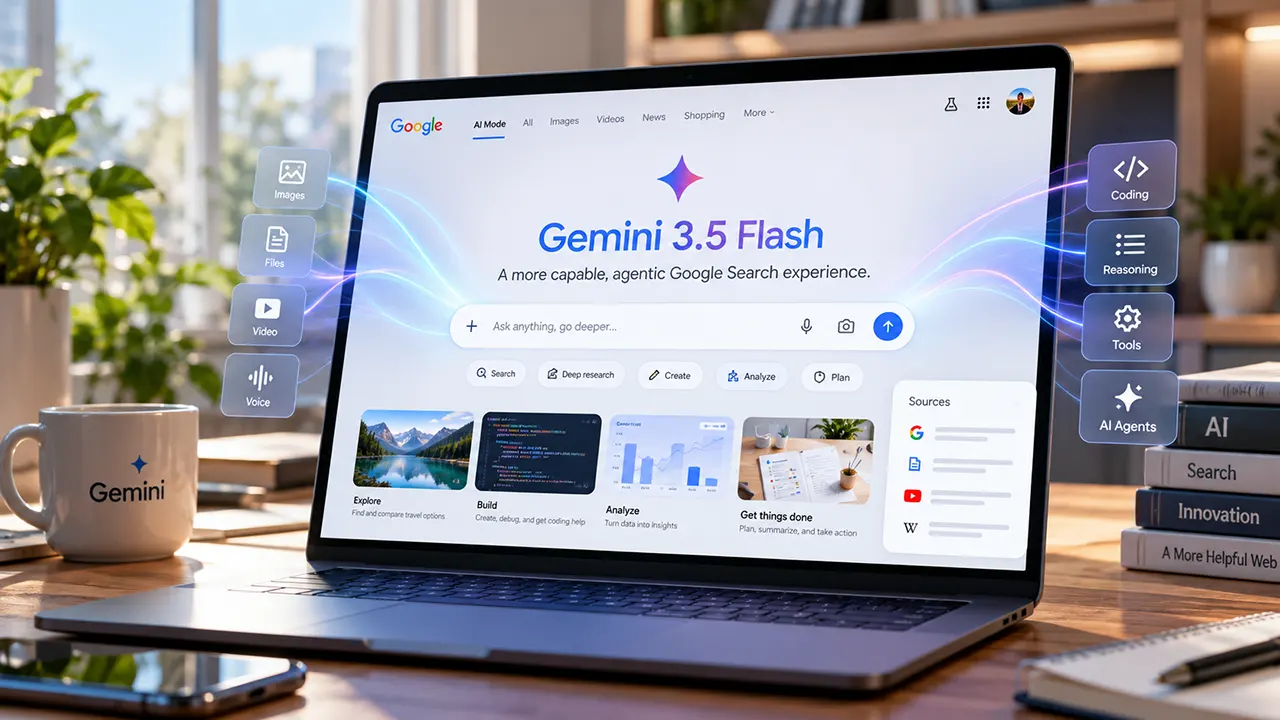
Gemini 3.5 Flash at a Glance
Gemini 3.5 Flash is Google’s Flash-series AI model designed for high-speed reasoning, coding, multimodal understanding, and agentic tasks. Google launched it on May 19, 2026, making it available through the Gemini app, Google Search’s AI Mode, Gemini API, Google AI Studio, Android Studio, and other Google products. It supports a 1-million-token context window, thinking, tool use, and Computer Use.
The important story is not simply that Gemini became faster. Gemini 3.5 Flash was designed to combine strong reasoning with the ability to work through multi-step tasks and use tools. That combination helped Google move Search toward a more conversational and agentic experience.
What Is Gemini 3.5 Flash?
Gemini 3.5 Flash is a general-purpose Gemini model built by Google DeepMind. It belongs to Google’s Flash line, which focuses on delivering strong AI capabilities with low latency and efficient execution.
Google introduced Gemini 3.5 Flash as its first Gemini 3.5 model, positioning it around frontier performance for coding, agentic execution, and long-horizon tasks. The model became generally available through the Gemini API and Google’s developer platforms at launch.
The model ID for developers is gemini-3.5-flash. Google currently describes it in its API documentation as a stable model, while newer Flash generations have since been introduced. That distinction matters if you are reading older articles that describe Gemini 3.5 Flash as Google’s newest Flash model.
In simple terms, Gemini 3.5 Flash is built for situations where an AI system needs to do more than produce a quick answer. It can reason through a problem, work with different types of input, call tools, maintain context across turns, and support multi-step workflows.
That makes it particularly relevant to AI agents and the changing role of AI inside Google Search.
What Changed in Gemini 3.5 Flash?
Gemini 3.5 Flash represented a major shift in what Google expected from a Flash model. Instead of treating speed and intelligence as separate priorities, Google designed 3.5 Flash to combine fast execution with stronger reasoning and action-oriented capabilities.
Stronger reasoning with thinking controls
Gemini 3.5 Flash supports configurable thinking levels. Google documents minimal, low, medium, and high thinking levels, with medium as the default for the model. Higher thinking levels can be used when a task benefits from deeper reasoning, while lower levels can reduce latency and cost.
This gives developers more control over the trade-off between speed, cost, and reasoning depth.
There is also an important multi-turn improvement. Gemini 3.5 Flash can preserve reasoning context across turns when the relevant conversation history is maintained, which can help with tasks such as iterative debugging and code refactoring.
Stronger coding and agentic execution
Google launched Gemini 3.5 Flash with a strong focus on coding and agents. Google reported that the model outperformed Gemini 3.1 Pro on several challenging coding and agentic benchmarks, including Terminal-Bench 2.1, GDPval-AA, and MCP Atlas. Google also reported that 3.5 Flash produced output at roughly four times the speed of other frontier models in its comparison.
Those are Google’s benchmark results, not a guarantee that Gemini 3.5 Flash will outperform every competing model on every task. Benchmark performance varies by workload, prompt, evaluation method, and model version.
The broader change is more useful to understand: Flash was no longer positioned only as a fast answer engine. Google was building it as an engine for systems that can plan, use tools, and complete multi-step work.
A very large context window
Gemini 3.5 Flash supports a 1,048,576-token input context window and a maximum output of 65,536 tokens in the Gemini API.
A large context window matters when an AI system needs to work with substantial amounts of information in one task. That can include long documents, large codebases, multimedia inputs, or extended conversations.
Context size alone does not guarantee better results. The quality of the model’s reasoning and its ability to find the relevant information still matter.
Gemini 3.5 Flash vs Gemini 3.1 Pro
The easiest mistake is to assume that Pro is always better and Flash is simply faster. The reality is more nuanced.
Gemini 3.5 Flash was specifically optimized around agentic execution, coding, speed, and long-horizon tasks. Gemini 3.1 Pro was positioned as a more advanced reasoning model. Google reported that 3.5 Flash beat 3.1 Pro on several of its selected coding and agentic benchmarks, but that does not make Flash universally superior.
| Feature | Gemini 3.5 Flash | Gemini 3.1 Pro |
|---|---|---|
| Main positioning | Fast frontier performance and agentic execution | Advanced reasoning and complex problem solving |
| Thinking | Minimal, low, medium, high | Low, medium, high |
| Context window | 1M tokens | Large-context model |
| Coding | Major strength | Major strength |
| Agentic workflows | Major strength | Strong |
| Multimodal input | Yes | Yes |
| Best fit | Fast, multi-step, tool-driven workloads | Demanding reasoning and complex analysis |
For a developer building an agent that must repeatedly reason, call tools, inspect results, and continue working, Gemini 3.5 Flash can be a compelling choice.
For a task where maximum reasoning depth matters more than latency or throughput, a Pro-class model may be a better fit.
The right question is therefore not “Which model is better?” It is “Which model is better for this workload?”
Why Google Uses Gemini 3.5 Flash in AI Mode
Google’s May 2026 Search announcement marked a significant change: Google made Gemini 3.5 Flash the default model in AI Mode globally. The company positioned the model as the engine for more capable AI Search, including multimodal input, agentic capabilities, and richer generated experiences.
The reason Flash made sense for Search is straightforward. Search has to handle a huge number of requests, and users generally do not want to wait for every answer.
A model used inside Search needs to balance several competing demands:
- Reason about complex questions.
- Respond quickly.
- Understand different input types.
- Work with tools and external information.
- Handle follow-up questions.
- Support increasingly agentic experiences.
Gemini 3.5 Flash was designed around that combination.
However, there is an important freshness caveat for anyone reading this article later. Google’s current API model catalog now lists Gemini 3.5 Flash as a legacy Flash model and shows newer Gemini 3.6, 3.7, and 3.8 Flash generations. Google has not announced a shutdown date for Gemini 3.5 Flash, but model deployment in consumer products can evolve independently from the API model catalog.
So the enduring lesson is bigger than the specific model name: Google is increasingly using fast, reasoning-capable models to transform Search from a link-finding interface into an AI-assisted problem-solving interface.
What Gemini 3.5 Flash Does in Google Search
The impact of Gemini 3.5 Flash becomes easier to understand when you stop thinking about Search as a list of keywords.
Google’s 2026 Search announcements described AI Mode as an experience where people can ask more complex questions, continue conversations, and use different forms of input. Google also announced support for text, images, files, videos, and Chrome tabs in the upgraded Search experience.
That creates several important changes.
Complex questions become more natural
Traditional Search works extremely well for direct queries such as “best laptop under $1,000” or “what time does the store open?”
AI Mode is designed for questions that are harder to express as a conventional keyword query.
A user can describe a problem in natural language, provide additional context, and continue with follow-up questions rather than creating a completely new search each time.
Search can reason across multiple inputs
Google’s 2026 Search announcement described multimodal Search that can work across text, images, files, videos, and Chrome tabs.
That matters because real questions are rarely limited to text.
A person might have:
- A photo of a product.
- A PDF containing specifications.
- A webpage open in Chrome.
- A question about how those pieces relate.
A multimodal AI system can reason across those inputs rather than forcing the user to describe everything manually.
Search can generate richer experiences
Google also announced generative UI capabilities in Search powered by Antigravity and the agentic capabilities of Gemini 3.5 Flash.
Instead of returning only a paragraph, Search can dynamically create interfaces such as visual explanations, tables, graphs, or simulations for certain queries.
This is an important change because the output of Search no longer has to be just “text plus links.”
The interface itself can become part of the answer.
Gemini 3.5 Flash’s Multimodal Capabilities
Gemini 3.5 Flash was designed to understand more than plain text. Google’s API documentation supports multimodal workloads and identifies text, image, video, audio, and PDF inputs among the model’s supported capabilities.
This matters in practical situations.
Imagine giving an AI system a long PDF and asking it to identify key sections. Or providing an image and asking it to explain what is visible. Or combining a document with a question that requires reasoning across several parts of the file.
The model’s large context window gives it room to process substantial inputs, while its multimodal capabilities allow those inputs to go beyond text.
Developers can also combine Gemini 3.5 Flash with tools such as Google Search grounding, code execution, URL context, and function calling.
One important distinction remains: a model’s API capabilities do not mean every consumer Google product exposes every capability in exactly the same way. Google controls which features are available in each product and can change those capabilities over time.
Gemini 3.5 Flash and AI Agents
AI agents are one of the biggest reasons Gemini 3.5 Flash matters.
A conventional chatbot generally follows a simple pattern:
Question → Answer
An agentic system can follow a longer process:
Goal → Plan → Use tools → Inspect results → Continue → Complete task
Gemini 3.5 Flash was designed for this second category.
Google describes it as particularly strong for agentic execution and long-horizon tasks. Its tool capabilities include function calling, code execution, Search grounding, and Computer Use.
Computer Use is especially important because it allows a supported Gemini model to interact with graphical user interfaces through computer-use actions. Google’s current documentation lists Gemini 3.5 Flash as a previous stable model supporting Computer Use, while newer models are now recommended for some computer-use workloads.
Google also introduced Managed Agents in the Gemini API in 2026. These agents can reason, use tools, and execute code inside isolated Google-hosted environments.
The larger implication is clear: Google’s AI strategy is moving beyond systems that simply generate responses.
The goal is increasingly to build systems that can act on a user’s behalf.
Gemini 3.5 Flash for Developers
For developers, Gemini 3.5 Flash is more than a model inside the Gemini app.
The model is available through the Gemini API and Google AI Studio, with support for features such as thinking, function calling, code execution, Search grounding, URL context, and Computer Use.
The model ID is:
Its 1,048,576-token input context and 65,536-token maximum output give developers substantial room for long-context workloads.
Gemini 3.5 Flash API pricing
Google’s current Gemini API pricing lists Gemini 3.5 Flash at $1.50 per 1 million input tokens and $9 per 1 million output tokens on the standard paid tier. Google also lists a free tier for the model.
Pricing can change, so developers should check Google’s current pricing page before building a production cost model.
This is particularly important for agentic applications because one user request can involve multiple model calls and tool calls. A system that looks inexpensive per individual response can become more expensive when it performs a long sequence of actions.
Does Gemini 3.5 Flash Make Google Search Better?
It can make Search more capable, but “better” depends on what you want from Search.
For complex questions, conversational follow-ups, multimodal input, and agentic tasks, the model can provide capabilities that a traditional keyword-results page cannot.
Google’s 2026 Search updates specifically connected Gemini 3.5 Flash with multimodal Search, agentic experiences, and generative UI.
But AI capability does not remove the need for verification.
A model can still misunderstand a question, make an incorrect inference, or produce an answer that sounds more certain than the evidence supports. Search grounding and links to sources can help, but users should still check important claims.
There is another practical issue: AI Mode is a product experience, not simply an API endpoint. Google can change the model, interface, tools, ranking systems, or available features without changing what users mean when they search.
That is why the most durable way to understand Gemini 3.5 Flash is as part of Google’s broader transition toward reasoning and agentic Search.
Gemini 3.5 Flash vs Traditional Google Search
The difference is easiest to see as a change in the user’s role.
| Traditional Google Search | AI Search with Gemini-class models |
|---|---|
| User formulates keywords | User can describe a problem conversationally |
| Results are primarily links and pages | AI can synthesize information with supporting links |
| Follow-up often means another search | Follow-up can continue the conversation |
| Primarily text-oriented | Can support multiple input types |
| User assembles information | AI can help synthesize information |
| Mostly retrieval-focused | Increasingly reasoning and task-focused |
This does not mean traditional Search disappears.
Google has repeatedly emphasized that AI Search continues to provide links and a range of Search results. The newer experience adds an AI layer on top of Search rather than simply throwing away the web.
That distinction is important for publishers and SEO professionals, too.
The future of Search is not necessarily “AI instead of websites.”
It is increasingly AI helping users discover, understand, compare, and interact with information from the web.
Who Should Use Gemini 3.5 Flash?
Gemini 3.5 Flash is especially relevant to people who need a balance of intelligence, speed, and tool use.
Everyday AI users
It is useful when a question needs more than a short factual response, particularly when follow-up questions or multimodal input are involved.
Developers
Developers can use it for applications that need reasoning, coding, tool calling, Search grounding, and long-context processing.
AI agent builders
This is one of its strongest use cases. The model was specifically designed for multi-step and agentic workflows.
Programmers
Coding is one of the areas Google emphasized at launch, making Gemini 3.5 Flash relevant to code generation, debugging, refactoring, and agentic development workflows.
Businesses
Companies building automated workflows can use an agentic model to coordinate multiple steps, analyze information, and interact with external tools.
The key is not to choose Gemini 3.5 Flash simply because its name is newer or because Google promotes it. Match the model to the workload, latency requirement, budget, and tool requirements.
Recommended: Learn how to use Google Ai Mode.
Gemini 3.5 Flash Limitations to Know
Gemini 3.5 Flash is powerful, but it is not a universal solution.
Model availability changes
Google’s model lineup is evolving quickly. The current Gemini API catalog lists newer Flash generations, while Gemini 3.5 Flash remains available as a stable legacy model with no announced shutdown date.
That means articles, tutorials, and code examples can become outdated faster than they would with conventional software.
API capabilities and product capabilities differ
A feature documented for the Gemini API may not appear in the Gemini app or Google Search in the same way.
Always distinguish the model’s technical capabilities from the features exposed by a particular Google product.
AI output still needs verification
Reasoning ability does not guarantee factual accuracy. For important decisions, verify claims against reliable sources.
Agentic workflows add complexity
The more an AI system can do, the more important permissions, tool controls, error handling, monitoring, and safety become.
A system that can call tools or interact with a computer needs stronger safeguards than a system that only generates text.
Pricing depends on usage
For developers, model cost is only one part of the total cost. Long conversations, multiple tool calls, Search grounding, and repeated agent steps can increase usage.
Frequently Asked Questions
1. What is Gemini 3.5 Flash?
Gemini 3.5 Flash is a Google AI model designed for fast reasoning, coding, multimodal understanding, and agentic execution. Google launched it in May 2026 and made it available through the Gemini app, AI Mode in Search, the Gemini API, Google AI Studio, and other platforms.
2. Is Gemini 3.5 Flash free?
Gemini 3.5 Flash has a free tier through the Gemini API, while paid API usage is billed according to Google’s token-based pricing. The current standard paid price is $1.50 per million input tokens and $9 per million output tokens. Product-level access can differ from API pricing.
3. Is Gemini 3.5 Flash used in Google AI Mode?
Google announced Gemini 3.5 Flash as the default model for AI Mode globally in May 2026. However, Google’s model ecosystem has continued to evolve, so readers should not assume that the same model will remain the default indefinitely.
4. What is Gemini 3.5 Flash best for?
Gemini 3.5 Flash is particularly well suited to coding, agentic workflows, long-context tasks, multimodal processing, and applications where reasoning quality and response speed both matter. Google specifically positioned it around agentic execution and coding.
5. Is Gemini 3.5 Flash better than Gemini 3.1 Pro?
Not in every situation. Google reported that Gemini 3.5 Flash outperformed Gemini 3.1 Pro on several coding and agentic benchmarks, but model choice depends on the workload. Flash emphasizes speed and agentic execution, while Pro models target demanding reasoning tasks.
6. What is the context window of Gemini 3.5 Flash?
Gemini 3.5 Flash supports a 1,048,576-token input context window and a maximum output of 65,536 tokens through the Gemini API. This makes it suitable for large documents, long conversations, codebases, and other long-context workloads.
7. Does Gemini 3.5 Flash support multimodal input?
Yes. Google’s documentation supports multimodal workloads for Gemini 3.5 Flash, including text, images, video, audio, and PDF inputs. The exact experience depends on the Google product or API feature being used.
8. Does Gemini 3.5 Flash support computer use?
Yes. Gemini 3.5 Flash supports Google’s Computer Use capability. However, Google’s current documentation recommends newer Gemini Flash models for some computer-use workloads, so developers should check the latest model guidance before starting a new implementation.
The Bigger Shift Behind Gemini 3.5 Flash
Gemini 3.5 Flash is important for a reason that goes beyond one model’s benchmark scores.
Google is changing what it expects an AI system to do.
The older mental model was simple: ask a question and receive an answer.
The newer model is closer to: describe a goal, give the system context, let it reason through the problem, allow it to use appropriate tools, and receive a result in a useful format.
Gemini 3.5 Flash was one of Google’s clearest steps toward that future. It brought strong reasoning, multimodal understanding, coding, tool use, and agentic execution together in a model designed to operate quickly at scale.
For Google Search, that shift matters even if Gemini 3.5 Flash eventually stops being the newest model in the stack.
The bigger change is that Search is becoming less about finding a single page and more about helping users investigate, understand, compare, and act.
For readers who want to understand that broader transformation, the next useful step is learning how Google AI Mode works and how it changes the traditional Search experience.

Belayet Hossain is a Senior Tech Expert and Certified AI Marketing Strategist. Holding an MSc in CSE (Russia) and over a decade of experience since 2011, he combines traditional systems engineering with modern AI insights. Specializing in Vibe Coding and Intelligent Marketing, Belayet provides forward-thinking analysis on software, digital trends, and SEO, helping readers navigate the rapidly evolving digital landscape. Connect with Belayet Hossain on Facebook, Twitter, Linkedin or read my complete biography.