

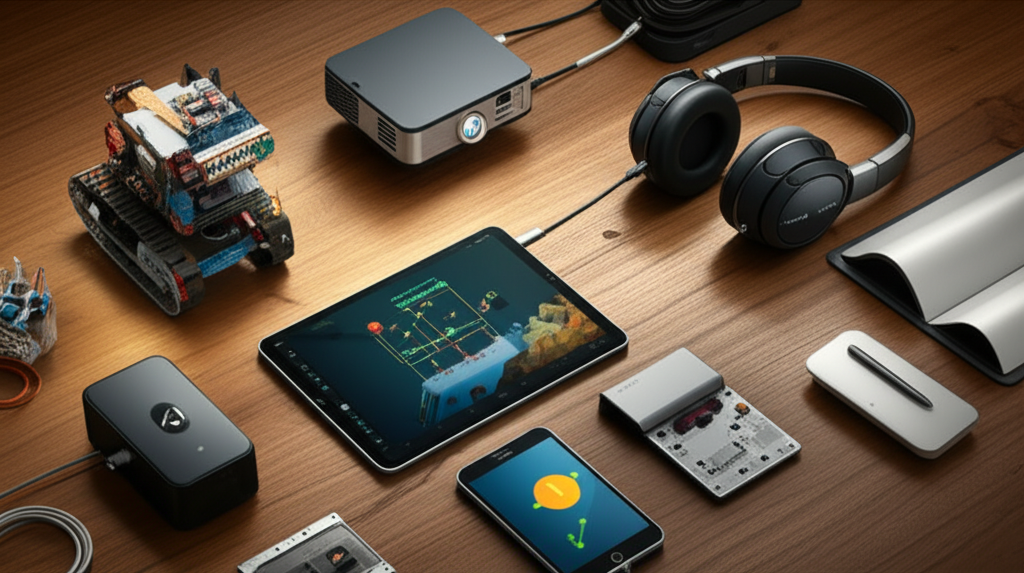
Discover 10 game-changing educational gadgets that make learning smarter and more engaging. These essential tools leverage technology to enhance understanding, retention, and skill development for students everywhere.
Learning has always been about adapting and growing. In our fast-paced world, technology offers incredible new ways to absorb information and master skills. Sometimes, the right tool can make all the difference, turning a challenging subject into an exciting exploration. If you’re looking to supercharge your studies or help someone else do the same, you’re in the right place. We’ll explore some of the most ingenious gadgets available today. These aren’t just toys; they’re powerful allies in the quest for knowledge. Get ready to see how these 10 examples of gadgets can redefine the educational experience.
10 Examples Of Gadgets
1. Smart Notebooks: Bridging the Analog and Digital Divide
Smart notebooks offer a revolutionary way to capture notes, blending the tactile satisfaction of handwriting with the convenience of digital storage. They allow you to write naturally with a pen, but your notes are instantly digitized, searchable, and shareable. This technology preserves the cognitive benefits of writing by hand while providing the efficiency of digital organization.
Many smart notebooks use special paper and pens that communicate with a companion app. Once synced, your handwritten notes can be converted to text, organized into folders, and even searched. This makes finding specific information incredibly easy, a huge advantage for students dealing with vast amounts of data. Some models also allow for easy sharing via email or cloud services, streamlining collaboration and study group efforts.
- Pros: Natural writing feel, instant digital backup, searchable notes, environmentally friendly (reusable options available).
- Cons: Requires a specific pen and notebook, initial cost can be higher than traditional notebooks.
The ability to write by hand and have those thoughts seamlessly appear in a digital format is a powerful combination for modern learning. It respects traditional methods while embracing technological advantages.
2. E-Readers: A Library in Your Pocket
E-readers have transformed how we access and consume books, making a vast collection of educational materials readily available. They offer a comfortable reading experience, often with adjustable font sizes and built-in lighting, perfect for long study sessions. Unlike tablets, their e-ink displays are designed to mimic real paper, significantly reducing eye strain.
With an e-reader, you can carry hundreds or even thousands of textbooks, novels, and research papers without the weight. Features like built-in dictionaries, highlighting, and note-taking capabilities further enhance their educational utility. Many e-readers also offer Wi-Fi connectivity, allowing for instant downloads of new resources. This accessibility democratizes knowledge, putting a world of information at your fingertips.
According to a 2023 report by Statista, the global e-reader market is projected to continue its growth, indicating a sustained interest in this focused reading device.
- Pros: Portable, lightweight, long battery life, easy on the eyes, access to a huge library of books.
- Cons: Limited functionality beyond reading, can be less interactive than tablets for multimedia content.
E-readers provide an unparalleled portable and comfortable way to engage with a wide array of written educational content. They are ideal for deep reading and research.
3. Portable Projectors: Dynamic Presentations Anywhere
Portable projectors bring the classroom or lecture hall experience to any space, making learning more interactive and collaborative. These compact devices can transform a plain wall into a dynamic display for presentations, videos, or group study sessions. Their small size and battery-powered options mean you can set up an impromptu learning environment almost anywhere.
Imagine a study group projecting notes onto a wall for shared review, or a student using one to present their project to family. Many modern portable projectors offer high-definition resolution and easy connectivity via HDMI, USB, or wireless casting. This allows for seamless integration with laptops, tablets, and smartphones, offering incredible flexibility. They are excellent for visual learners and for fostering collaborative discussion.
- Pros: Large screen projection, enhances collaboration, portable and versatile, can be used for entertainment too.
- Cons: Image quality can vary, requires a suitable surface for projection, ambient light can affect visibility.
Portable projectors are fantastic tools for creating shared learning experiences and visual aids on demand. They turn any surface into an educational hub.
4. Digital Voice Recorders: Capturing Every Detail
For students who struggle to keep up with fast-talking lecturers or prefer to focus on listening, digital voice recorders are invaluable. They allow you to capture lectures, discussions, or your own study notes with high clarity. Later, you can replay these recordings at your own pace, pausing, rewinding, and reviewing as needed to ensure you don’t miss any crucial information.
Modern digital recorders are often small, easy to use, and offer significant storage capacity. Many also feature noise-cancellation technology to improve audio quality, even in noisy environments. Some advanced models can even transcribe audio to text, further streamlining the note-taking process. This gadget is a lifesaver for auditory learners and those who need to revisit information multiple times.
- Pros: Captures lectures accurately, allows for repeated review, reduces note-taking pressure, improves focus during class.
- Cons: Storage space limitations on some devices, requires listening time later, can be less useful for visual information.
Digital voice recorders ensure that no important information is lost, providing a reliable way to revisit and reinforce learning. They empower students to listen and learn at their own pace.
5. Interactive Whiteboards/Displays: Engaging Visual Learning
Interactive whiteboards and displays have moved beyond the classroom, becoming powerful tools for home study and collaborative learning. These large touch-sensitive screens allow users to write, draw, annotate, and manipulate content directly on the display. They transform static information into dynamic, engaging experiences, making complex subjects easier to understand.
With an interactive display, you can pull up websites, annotate over videos, work through math problems together, or even play educational games. They facilitate a more hands-on approach to learning, encouraging participation and deeper engagement. Connectivity with computers and the internet opens up a world of resources that can be explored interactively. This is particularly beneficial for subjects that benefit from visualization and hands-on manipulation.
Research from educational technology journals consistently highlights the positive impact of interactive displays on student engagement and learning outcomes.
- Pros: Highly engaging, promotes collaboration, supports visual and kinesthetic learning, versatile for various subjects.
- Cons: Can be expensive, requires space, dependent on power and connectivity.
Interactive whiteboards and displays foster a dynamic and collaborative learning environment. They make complex concepts tangible and engaging for all learners.
6. AI-Powered Learning Apps and Devices: Personalized Tutoring
Artificial intelligence is revolutionizing education, and AI-powered learning apps and devices are at the forefront. These tools offer personalized learning experiences tailored to an individual’s pace, strengths, and weaknesses. They can adapt questions, provide instant feedback, and identify areas where a student needs more practice, acting like a dedicated tutor.
From language learning apps that correct pronunciation to math programs that adapt problem difficulty, AI offers bespoke educational support. Some devices even incorporate AI to answer questions in real-time or generate study materials. This level of personalization can significantly accelerate learning and improve retention. It ensures that no student is left behind or held back.
A report by Statista projects the global AI market to reach substantial figures, underscoring the growing integration of AI across all sectors, including education.
- Pros: Personalized learning paths, immediate feedback, adaptive difficulty, accessible 24/7.
- Cons: Can be subscription-based, may lack the human touch of a live tutor, requires reliable internet access.
AI-driven educational tools provide customized support, adapting to individual learning styles and needs for efficient progress. They offer a glimpse into the future of personalized instruction.
7. Portable Document Scanners: Organizing Study Materials
Keeping track of handouts, notes, and important documents can be overwhelming. A portable document scanner is a compact gadget that allows you to digitize paper materials quickly and easily. This means no more lost notes or bulky binders; everything can be stored, organized, and searched digitally.
These scanners are often small enough to fit in a backpack and can scan directly to a USB drive, SD card, or a connected smartphone or tablet. This makes it simple to create digital archives of lecture notes, research papers, or even textbook pages. Being able to quickly scan and store information saves time and reduces clutter, allowing you to focus on studying rather than managing paper.
- Pros: Digitize documents on the go, reduces paper clutter, easily searchable archives, saves time.
- Cons: Scan quality can vary, requires manual feeding of documents, some models have limited battery life.
Portable document scanners are essential for maintaining an organized and accessible digital repository of all your study materials. They bring order to the academic chaos.
8. Smart Pens: Handwriting Meets Digital Precision
Smart pens take the concept of smart notebooks a step further, acting as standalone devices that capture your writing and drawings digitally. You can write on any paper, and the pen transmits your strokes to a connected device in real-time. This offers incredible flexibility, as you’re not limited to special paper.
These pens often come with advanced features like audio recording synchronized with your notes, allowing you to tap on a word and hear what was being said at that exact moment. They also typically support handwriting-to-text conversion and can be used for digital drawing and annotation. For students who prefer the feel of writing on paper but need digital capabilities, a smart pen is an ideal solution.
Brands like Livescribe have been pioneers in this field, offering robust features for note-taking and learning.
- Pros: Works on any paper, captures audio synchronized with notes, converts handwriting to text, portable.
- Cons: Requires charging, may have a learning curve for advanced features, can be more expensive than traditional pens.
Smart pens offer a seamless bridge between traditional writing and digital efficiency. They enhance note-taking by adding layers of interactivity and detail.
9. Portable Language Translators: Breaking Down Communication Barriers
For students studying abroad, engaging with international resources, or learning a new language, portable language translators are indispensable gadgets. These devices can translate spoken words or text in real-time, facilitating communication and understanding across different languages.
Modern translators are highly accurate and support dozens of languages. Many also function as text translators for signs or documents, and some even offer offline modes for use without an internet connection. This gadget not only aids in academic pursuits but also enriches cultural understanding and global awareness. It makes the world a smaller, more accessible place for learners.
- Pros: Real-time translation, supports multiple languages, facilitates communication, aids language learning.
- Cons: Accuracy can vary with complex sentences or accents, offline modes may have limited functionality, requires battery power.
Portable language translators are crucial for global learning and communication. They empower students to connect and comprehend across linguistic divides.
10. Advanced Calculators & Graphing Tools: Mastering Math and Science
While smartphones can perform calculations, dedicated advanced calculators and graphing tools offer superior functionality and precision for STEM fields. These devices are specifically designed for complex mathematical operations, scientific formulas, and data visualization, providing features often not found or easily accessible on general-purpose devices.
Graphing calculators, for example, allow students to visualize functions, analyze data sets, and solve equations graphically, which is fundamental for understanding calculus, physics, and engineering concepts. Many also offer programming capabilities for advanced users. For standardized tests like the SAT or AP exams, specific approved calculators are often required, making these tools essential for academic success in these subjects.
The Texas Instruments graphing calculators are a staple in many high school and university math and science programs worldwide.
- Pros: Specialized functions for STEM, precise calculations, data visualization, often required for exams.
- Cons: Can be expensive, may have a steep learning curve, limited general-purpose use.
Advanced calculators and graphing tools are non-negotiable for serious students in mathematics and science. They provide the power and precision needed to tackle complex problems.
Frequently Asked Questions (FAQ)
What is the best gadget for a student who struggles with note-taking?
For students who struggle with traditional note-taking, a digital voice recorder is excellent for capturing lectures to review later. A smart pen or smart notebook is also ideal, as it bridges handwriting with digital organization and searchability.
Are AI learning apps truly effective for education?
Yes, AI learning apps can be highly effective by providing personalized learning paths, adaptive exercises, and instant feedback. They cater to individual learning paces and identify specific areas needing improvement, complementing traditional teaching methods.
Which gadget is best for reading textbooks and academic papers?
An e-reader is the best gadget for reading textbooks and academic papers due to its eye-friendly e-ink display, long battery life, and portability. It allows for adjustable font sizes and easy access to a vast digital library without the bulk.
Can portable projectors be used for study groups?
Absolutely! Portable projectors are fantastic for study groups. They can display notes, diagrams, or online resources on a large surface for everyone to see and discuss, fostering collaboration and shared understanding.
Are there any gadgets that help with language learning?
Yes, portable language translators are incredibly helpful for language learners. They offer real-time translation for conversations and text, breaking down communication barriers and aiding in comprehension and practice.
Conclusion: Equipping Yourself for Modern Learning
Exploring these 10 examples of gadgets reveals just how technology can profoundly enhance the educational journey. From the simple act of capturing notes with a smart pen to the complex analysis enabled by graphing calculators, each device offers a unique advantage. Whether you’re a student, educator, or lifelong learner, investing in the right educational gadgets can unlock new levels of understanding, efficiency, and engagement. These tools are not just about convenience; they are about empowering you to learn more effectively and to tackle subjects with greater confidence.
By integrating these innovative devices into your study routine, you can make learning more accessible, interactive, and ultimately, more successful. We encourage you to consider which of these essential educational gadgets best fits your learning style and needs. The future of learning is here, and it’s equipped with some truly genius tools.

Belayet Hossain is a Senior Tech Expert and Certified AI Marketing Strategist. Holding an MSc in CSE (Russia) and over a decade of experience since 2011, he combines traditional systems engineering with modern AI insights. Specializing in Vibe Coding and Intelligent Marketing, Belayet provides forward-thinking analysis on software, digital trends, and SEO, helping readers navigate the rapidly evolving digital landscape. Connect with Belayet Hossain on Facebook, Twitter, Linkedin or read my complete biography.