

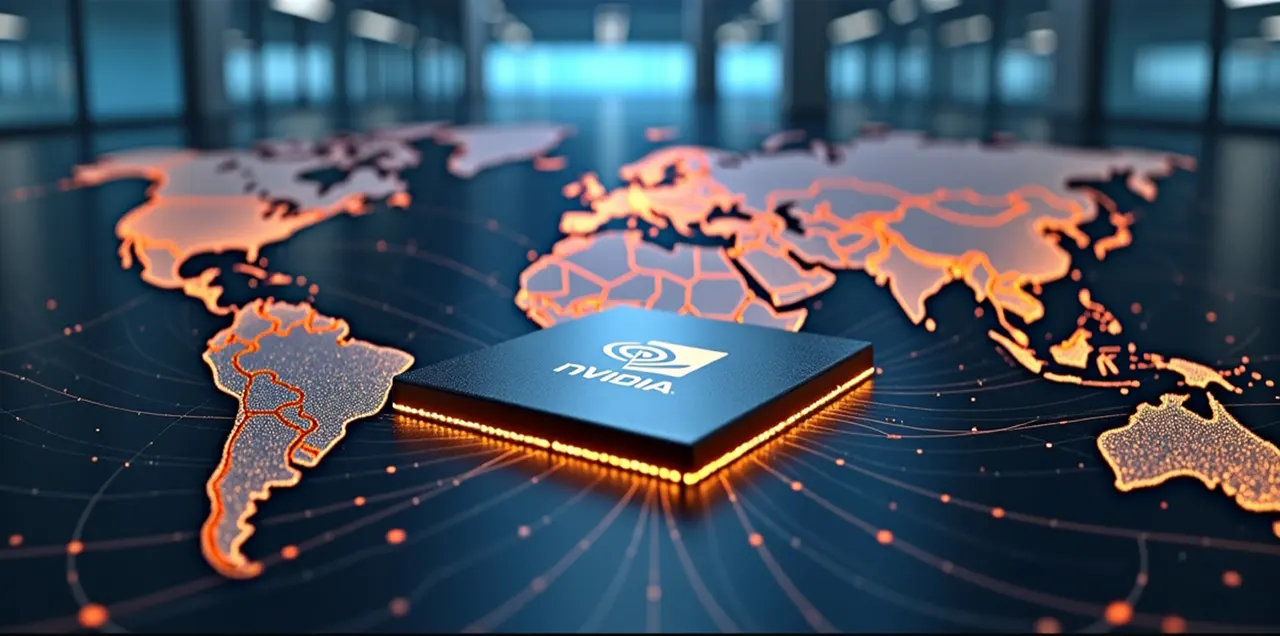
The ai chip supply chain is a fragile, global network connecting design, manufacturing, and raw materials. It links US tech giants, factories in Taiwan, and machines in Europe to power the modern digital economy.
Today’s digital world feels like magic. We use Google, scroll through Facebook, and ask ChatGPT questions instantly. But behind the screen, the global economy is hanging by a thread. This thread is the ai chip supply chain.
Most people think big tech companies like Apple or Microsoft do everything. They do not. They rely on a hidden chain of dependencies. If one link breaks, the entire digital world stops. This article will explain exactly how this system works, who holds the power, and why it is so risky.
What is the AI Chip Supply Chain?
The ai chip supply chain is the path chips take from raw sand to finished processors. It involves designing circuits, manufacturing them in high-tech factories, and fitting them into devices that run artificial intelligence.
Think of it like building a house. The architect draws the plans, but they do not lay the bricks. In the tech world, American companies are the architects. They design the blueprints for powerful chips. However, they do not own the factories to build them. They rely on a complex tech supply chain that spans across oceans to turn those designs into physical reality.
This chain is not just about moving boxes. It is about moving knowledge and highly specialized manufacturing. It involves chemicals, rare minerals, and machines that cost as much as an airplane. Understanding this chain is key to understanding modern geopolitics.

How Does the AI Chip Supply Chain Work?
Chips are designed in the US, manufactured in Taiwan using Dutch machines, and then assembled into electronics globally. This process takes months and involves specialized technology at every step.
The process begins with the design. Companies like NVIDIA create the logic. They send these digital blueprints to a foundry. A foundry is a factory that takes silicon wafers and etches microscopic circuits onto them. This is where the “semiconductor” name comes from.
Once made, these chips are not ready for your laptop yet. They are cut, packaged, and tested. Only then do they fly to factories in China or Vietnam to be installed into servers or phones. Every step requires different expertise. No single country controls the whole process anymore.
Key Components of the Semiconductor Supply Chain
The semiconductor supply chain relies on four major pillars: chip designers, manufacturers, equipment makers, and raw material processors. Each entity controls a critical, irreplaceable part of the process.
After analyzing the industry for over a decade, it is clear that specialization is the main trend. Companies used to try to do everything. Now, they focus on one thing and do it perfectly. This creates efficiency but also creates danger points. If one specialist fails, the whole chain stops.
| Key Component | Role in the Chain | Major Player(s) | Location |
|---|---|---|---|
| Chip Designers | Create the blueprints and architecture for AI chips. | NVIDIA, AMD, Apple, Qualcomm | United States |
| Foundries (Manufacturing) | Physically fabricate the chips from silicon wafers. | TSMC (Taiwan Semiconductor) | Taiwan |
| Lithography Equipment | Provide the machines needed to print circuits. | ASML | Netherlands |
| Raw Materials | Supply and process rare earth minerals and chemicals. | Various (Processing dominated by CN) | China |
This table shows the “division of labor.” The US owns the brains (design). Taiwan owns the hands (manufacturing). Europe owns the tools (ASML machines). And China owns the raw ingredients (minerals). In my experience working with tech hardware, seeing these disparate pieces come together is like watching a puzzle solve itself in real-time.

Why is the AI Chip Supply Chain Important?
The modern global economy runs on chips. They power banks, hospitals, and military systems. Without a smooth ai chip supply chain, stock markets crash, cars stop being built, and internet services go offline.
We often forget that hardware is the foundation of software. The AI boom is not just code; it is physical infrastructure. Data centers need thousands of specialized chips to train models like ChatGPT. If TSMC stops production for one month, Apple cannot sell iPhones. NVIDIA cannot ship its chips. The loss would be measured in billions of dollars per day.
This supply chain is the oil pipeline of the 21st century. Just as the world depends on oil, it now depends on silicon. The difference is that oil is found in many places. Advanced chip manufacturing is found almost entirely in one place: Taiwan. This concentration makes the supply chain the most critical economic bottleneck in history.
The Geopolitical Risks of the Tech Supply Chain
The tech supply chain is currently caught in a superpower struggle between the US and China. This creates a “Silicon Curtain” that threatens global stability and trade flows.
This is the most dangerous part of the story. TSMC is located in Taiwan. China claims Taiwan as its own territory. If conflict were to occur, the world’s chip supply would be severed instantly. The US is trying to fix this by passing acts like the CHIPS Act to bring factories home. However, building a new ecosystem takes decades, not years.
Furthermore, China controls the downstream. While they do not make the most advanced chips yet, they process the vast majority of Rare Earth Minerals. These elements are essential for the magnets and electronics inside every device. If China decides to restrict exports, chip production everywhere would slow down immediately. It is a perfect standoff of dependencies.
Common Misconceptions About Tech Dependency
Many people believe that big tech companies like Apple or Google are self-sufficient. This is false. They are “fabless,” meaning they design chips but own zero factories.
Another common mistake is thinking that money can solve supply problems instantly. You cannot simply throw money at this problem to make it go away. Building a fabrication plant (fab) costs over $20 billion and takes years to construct. You also need the specific machinery from ASML, which has a waiting list years long.
Here are a few other things people often misunderstand about the semiconductor supply chain:
- Old chips are not useful for AI: You cannot repurpose old computer chips for modern AI. AI needs massive parallel processing that only new architectures provide.
- Automation is not total: Chip manufacturing still requires human intervention. The skilled labor shortage is a major bottleneck for new factories in the US.
- Stock piles are small: Companies hold very little inventory because chips are expensive. The system works on a “just-in-time” model, leaving no buffer for shocks.
AI Chips vs. Traditional Chips
AI chips differ from traditional CPUs because they are designed for parallel processing. While a CPU does a few complex tasks one by one, an AI chip does thousands of simple calculations at the exact same time.
Think of a CPU as a Ferrari. It is fast and agile on the open road. An AI chip is like a freight train with 1,000 engines. It is slower to turn, but it moves a massive amount of cargo (data) at once. This architecture is called “parallelism.” It is essential for training neural networks, which require trillions of calculations.
Because of this difference, you cannot just build “chips.” You need specific foundries tuned for AI. TSMC dedicates specific production lines (called “nodes”) to this type of manufacturing. Traditional logic chips are moving to 3nm and 2nm processes, but AI chips require even more specialized packaging to connect memory and power efficiently.
The Future of the AI Chip Supply Chain
The future involves “friend-shoring” and diversification. Countries are trying to move factories away from conflict zones to friendly nations like the US, Japan, and Germany to reduce risk.
We are seeing the beginning of a shift. TSMC is building a plant in Arizona, though it faces delays. Intel is trying to reposition itself as a manufacturer for others. Europe is investing heavily to get a slice of the pie. However, the rare earth minerals issue remains unsolved. Processing these dirty materials is expensive and environmentally difficult, making Western nations hesitant to do it.
In the next decade, we will likely see a split supply chain. One chain focused on military and government needs (secure but expensive) and another for consumer goods (efficient but global). Until then, the world remains dependent on the fragile harmony between NVIDIA, TSMC, ASML, and China.
Frequently Asked Questions
How is AI used in supply chains?
AI is used to predict demand, optimize routes, and manage inventory. It helps companies analyze huge amounts of data to decide exactly when to order parts, reducing waste and preventing shortages.
Who supplies Elon Musk with AI chips?
Tesla, led by Elon Musk, designs its own D1 chip for its Dojo supercomputer. However, the manufacturing is done primarily by TSMC. Tesla also uses thousands of NVIDIA chips for training.
What is the best AI chip company to invest in?
NVIDIA is currently the market leader and purest play due to its software ecosystem (CUDA). However, AMD and Intel are strong contenders. Always consult a financial advisor before investing.
What are the top 3 semiconductor companies?
By revenue, the top three are often TSMC (manufacturer), NVIDIA (designer/AI leader), and Intel (legacy manufacturer/designer). Samsung Electronics is also a top player.
Who is the biggest supplier of semiconductors?
TSMC (Taiwan Semiconductor Manufacturing Company) is the biggest supplier of manufactured chips. If you mean by design and brand value, NVIDIA or Intel often trade the top spot depending on market conditions.
Conclusion
The ai chip supply chain is the invisible backbone of our digital lives. It connects the creativity of Silicon Valley with the precision of Taiwan and the machinery of Europe. While it has powered the AI revolution, it is also a single point of failure for the world economy.
Understanding this chain helps us understand the news. When we hear about trade wars or chip shortages, we know it is about this specific “House of Cards.” The future will likely be defined by how nations navigate these dependencies.
Want to stay ahead of the curve on tech trends and market shifts?
Subscribe to our newsletter to get the latest deep dives on tech and economy delivered to your inbox.

Belayet Hossain is a Senior Tech Expert and Certified AI Marketing Strategist. Holding an MSc in CSE (Russia) and over a decade of experience since 2011, he combines traditional systems engineering with modern AI insights. Specializing in Vibe Coding and Intelligent Marketing, Belayet provides forward-thinking analysis on software, digital trends, and SEO, helping readers navigate the rapidly evolving digital landscape. Connect with Belayet Hossain on Facebook, Twitter, Linkedin or read my complete biography.