


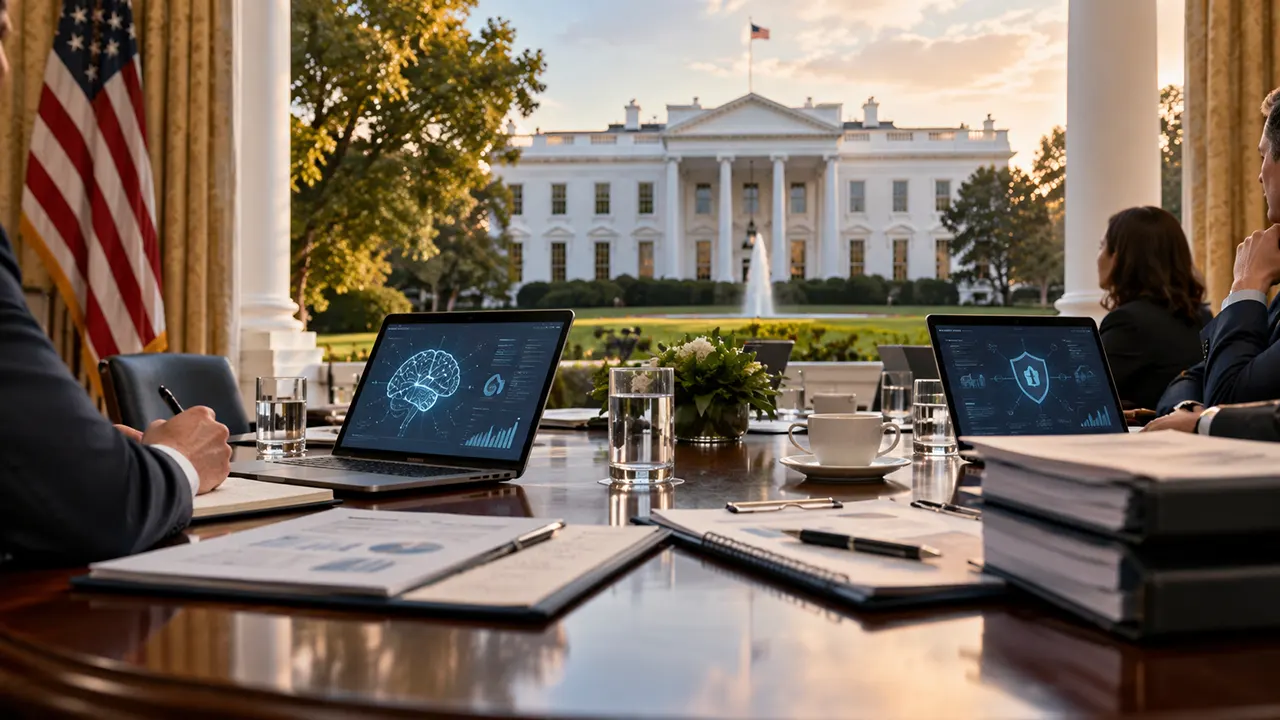
The White House AI safety agreement, officially titled the White House Accord on Super Intelligence, is a voluntary commitment signed on September 29, 2026, by President Donald Trump and leaders of six major technology companies. It calls for four layers of AI safety controls, including internal monitoring, independent external audits, and board oversight. The accord does not itself establish a legally enforceable regulatory regime.
Why the White House AI safety accord matters
The White House AI safety accord puts a specific question at the center of US AI policy: should powerful AI companies demonstrate that their safety controls work, even when the government has not imposed a new legal requirement to do so?
The September 29 agreement asks participating companies to monitor advanced AI models, investigate problems, obtain independent assessments, and give board-level committees oversight of those safeguards. It also says the companies will meet regularly to develop safety standards and best practices.
The announcement matters because frontier AI systems can perform increasingly complex tasks, including writing code and interacting with external tools. Safety controls must therefore address not only what a model says, but also what it can do when connected to other systems.
However, the announcement should not be confused with proof that the companies have implemented effective safeguards. The document sets out commitments and a governance structure. The quality of implementation must be evaluated separately.
What happened at the White House AI safety meeting on September 29, 2026?
President Trump met with technology executives at the White House on September 29, 2026, and released a one-page document titled the White House Accord on Super Intelligence, with the subtitle Joint Commitment on Frontier Responsibilities. The accord was presented as a voluntary agreement to strengthen AI safety practices.
The document identifies four layers of controls and audits. It also acknowledges that these steps could eventually be codified into laws or regulations, while stating that participating companies are committed to implementing them regardless of whether legislation requires it.
That wording establishes the central distinction: the companies are making commitments about their own practices, rather than accepting a new statutory audit regime created by the accord itself.
Which companies signed the agreement?
The reported signatories were President Trump and executives representing six technology companies:
- Google: Sundar Pichai
- Anthropic: Dario Amodei
- Meta: Mark Zuckerberg
- OpenAI: Greg Brockman
- xAI: Elon Musk
- Nvidia: Jensen Huang
Reuters reported these participants in its coverage of the released accord.
The agreement focuses on companies that train and deploy frontier models. Its stated commitments are therefore most directly relevant to advanced AI developers, rather than every business that uses a chatbot or integrates a third-party AI service.
What does the White House AI safety agreement require?
The accord asks participating companies to establish four layers of controls and audits. These layers combine technical safeguards, internal accountability, external evaluation, and board oversight.
| Layer | Stated commitment | Responsible party | Verification mechanism | Unresolved question |
|---|---|---|---|---|
| 1. Internal controls | Monitor model capabilities and alignment during training and deployment, including cybersecurity, biosecurity, and chemical risks | AI developer | Internal monitoring and detection | Which thresholds trigger intervention? |
| 2. Internal oversight | Ensure controls work as intended and identified problems are fixed | Internal team | Monitoring, detection, and remediation | How independent and adequately resourced is the team? |
| 3. External assessment | Obtain independent assessments of whether safeguards operate as intended | External auditor or evaluator, working with the company | Independent evaluation | Who selects the evaluator, and what standards apply? |
| 4. Board oversight | Establish an independent board committee to receive reports and oversee remediation | Company board | Board-level review and follow-up | What disclosure and escalation duties apply? |
The agreement’s text establishes the proposed structure, but it does not provide a detailed common audit methodology or a public compliance-scoring system.
Layer 1: Internal controls for AI model capabilities
The first commitment asks companies to monitor their models during training and deployment. The accord specifically identifies cybersecurity, biosecurity, and chemical threats, as well as preventing models from hacking or accessing technical systems in unintended ways.
This matters because a model’s capabilities and risks can change as developers train it, connect it to tools, or deploy it in a new environment.
For example, an AI coding agent may need different safeguards when it can only suggest code than when it can execute commands, access credentials, or modify production systems. A credible control system should reflect the model’s actual capabilities and permissions.
What to look for: Evidence that a company tests safeguards against relevant risks, monitors changes in model behavior, and responds when a control fails. A general statement that a model is safe is not equivalent to evidence that its safeguards work.
Layer 2: An internal team responsible for safety controls
The second commitment asks each company to empower an internal team to check that controls, monitoring, and detection are working as intended. The team is also expected to ensure that identified issues are remediated.
This creates an identifiable internal responsibility for safety operations. Without a team responsible for following up on findings, even a technically strong monitoring system may fail to produce corrective action.
The unresolved issue is authority. The published commitment does not specify staffing levels, budgets, reporting lines, or how disagreements between safety teams and product-development leaders should be resolved.
For readers evaluating a company’s AI governance, the important question is not simply whether a safety team exists. It is whether that team can escalate serious problems and obtain the changes needed to address them.
Layer 3: Independent external AI audits
The third commitment asks companies to work with an independent external auditor or evaluator to assess whether their controls, monitoring, and detection systems operate as intended.
This is one of the accord’s most important features because an external evaluation can provide scrutiny beyond a company’s internal reporting structure.
However, an independent audit is only as useful as its scope and execution. An evaluator needs appropriate access to the systems being assessed, clear evaluation criteria, sufficient technical competence, and the ability to report meaningful findings.
The accord does not name a common auditor, prescribe a universal testing standard, or specify how every external assessment must be conducted. Those details will determine how comparable and credible the resulting assessments are.
A useful distinction is that independent evaluation does not automatically mean public disclosure. The accord’s requirement for external assessment should not be interpreted as a blanket promise that companies will publish complete audit reports.
Layer 4: Independent board-level oversight
The fourth commitment asks companies to designate an independent committee of the board of directors. That committee should oversee and receive reports from internal teams and external auditors, and ensure that identified problems are addressed.
Board oversight can connect technical findings with corporate accountability. For example, if an external evaluator identifies a serious weakness, board-level review can help ensure the issue receives attention beyond the engineering team.
But the agreement does not specify a uniform escalation process, reporting timetable, or public disclosure requirement for every finding.
The practical test is whether the board committee receives meaningful information, can challenge management’s response, and follows issues through to resolution. Merely creating a committee does not establish that these responsibilities are being performed effectively.
Is the White House AI safety agreement legally binding?
The accord is a voluntary commitment, not a standalone binding regulation. Its wording asks companies to implement the four layers of controls and states that they are committed to doing so. It does not itself establish a regulator, penalty schedule, mandatory compliance deadline, or detailed enforcement process.
President Trump described the agreement as “morally binding,” according to ABC News. That phrase expresses the intended seriousness of the commitments, but it does not by itself create a legal obligation enforceable in court.
Three distinctions are important:
- Voluntary commitment: A company publicly agrees to follow a set of practices without the accord itself imposing a statutory penalty for noncompliance.
- Binding legislation or regulation: An applicable legal requirement that can be enforced by an authorized government body through the mechanisms provided by law.
- Existing legal obligations: Laws that may already apply to a company’s conduct independently of whether it signed the accord.
The absence of enforcement provisions in the accord does not mean AI companies are exempt from all applicable laws. Nor does it mean every statement a company makes about its safety practices is legally consequence-free. The legal effect of a specific claim or failure depends on the applicable law and facts.
What could make the commitments enforceable?
The accord itself says that codifying the proposed steps into laws or regulations may make sense over time.
Binding requirements could emerge through legislation, valid regulatory action, or other legally enforceable instruments. Their scope would depend on the language of those instruments, the authorities involved, and the companies and activities covered.
Readers should therefore distinguish an announced intention to develop policy from an enacted rule. A proposal, an executive statement, a voluntary accord, and a law do not have interchangeable legal effects.
How independent AI safety audits could work
A useful external audit should assess whether a company’s safeguards operate as intended, rather than simply confirm that written policies exist. The accord establishes the expectation of independent assessment but leaves important operational details open.
A practical assessment could examine several areas:
- Scope: Which models, deployment environments, and safety controls are included?
- Access: Can the evaluator inspect the relevant technical evidence and test the controls?
- Methodology: Are the tests and success criteria documented clearly enough to evaluate the results?
- Independence: Can the evaluator report material findings without inappropriate interference?
- Remediation: Are identified problems assigned, tracked, and resolved?
- Accountability: Does an appropriate governance body receive the findings and oversee corrective action?
These are evaluation criteria for judging implementation, not six additional requirements explicitly imposed by the accord.
Why auditor independence matters
An external organization may be independent in name but still face practical limits. Its contract, access rights, financial relationship with the company, and ability to communicate material findings can affect the quality of its work.
Readers should look for evidence about who commissioned the audit, what the evaluator was allowed to examine, and whether significant limitations were disclosed.
A short certification statement may be easy to communicate, but it can hide important differences in scope. An assessment of documentation alone is not equivalent to testing a model’s behavior under realistic conditions.
Must companies publish their AI audit results?
The published accord calls for independent assessments and board-level receipt of reports. It does not establish a universal requirement to publish complete external audit reports.
That leaves a transparency gap. Customers, researchers, and the public may have limited ability to evaluate an audit if its scope, methodology, limitations, and findings remain confidential.
Full disclosure may also involve legitimate security concerns, such as revealing exploitable weaknesses. A sensible transparency approach would distinguish information that can safely be published from sensitive technical details that require restricted access.
The important question is whether a company provides enough credible evidence to support its public safety claims, even when some details cannot be released.
What is missing from the public terms?
The accord sets out a high-level governance structure, but several details remain unspecified in the published text.
| Unresolved issue | Why it matters | Evidence to watch for |
|---|---|---|
| Common audit standards | Different evaluators may reach results that are difficult to compare | Published methodologies and shared criteria |
| Auditor selection and independence | Commercial relationships may affect scrutiny | Evaluator identities, qualifications, and conflict policies |
| Compliance deadlines | Readers cannot determine when implementation should be complete | Company implementation schedules |
| Reporting and disclosure | Public accountability depends on access to meaningful information | Audit summaries and disclosed limitations |
| Failure handling | A control can identify a problem without ensuring a timely response | Remediation records and escalation procedures |
| Consequences for noncompliance | The accord itself provides no detailed enforcement process | New laws, regulations, contracts, or other enforceable requirements |
These omissions do not prove that participating companies will fail to implement the agreement. They mean that the published text alone cannot establish how consistently implementation will occur or how outsiders will verify it.
What happens next for US AI oversight?
The next stage is to determine whether the accord produces observable changes in company practices, common evaluation standards, and government policy.
Voluntary standards versus government regulation
Voluntary standards can give companies room to adapt controls to different systems and risks. They may also allow safety practices to develop faster than legislation.
Their weakness is that companies may adopt different interpretations, disclose different amounts of information, or apply different thresholds for acceptable risk. Without common requirements and meaningful verification, it can be difficult to compare their performance.
Binding rules can establish clearer obligations, but their effectiveness still depends on the quality of the requirements, enforcement capacity, and technical implementation.
The central policy question is not whether voluntary standards or legislation must always replace one another. It is which safety outcomes require consistent, independently verifiable obligations and which can be achieved through company-level practices.
A separate executive order adds another policy dimension
On September 29, 2026, the White House also issued Executive Order 14434, titled Inaugurating the Era of Super Intelligence. The order directs executive-branch agencies, to the maximum extent permitted by law, to use the terms “Super Intelligence” and “SI” in place of “Artificial Intelligence” and “AI” in specified official communications and non-statutory documents.
This is a separate presidential action. It should not be presented as the legal mechanism that enforces the accord’s four safety commitments.
Readers following US AI policy should track the accord and the executive order independently, along with any later legislation or regulatory actions that establish enforceable obligations.
An October 2026 development raises further questions about industry self-regulation
A Reuters report published October 21, 2026, described a political dispute involving OpenAI President Greg Brockman. Brockman signed the voluntary AI safety accord on behalf of OpenAI, while he and his wife had contributed $25 million to Leading the Future, a political group opposing regulations it considers unduly restrictive of AI development. Reuters also reported that the group was spending money to influence at least 48 congressional races.
OpenAI said the donation was made in a personal capacity, not on behalf of the company. The political group’s spokesperson said it sought to support a strong national regulatory framework. The report also described disagreements between AI industry participants over federal preemption of state AI laws.
This is relevant context for the wider debate over self-regulation, but it does not establish whether OpenAI has complied with the accord or whether its technical safeguards are effective. Political contributions, public statements, and technical implementation are different forms of evidence and should be assessed separately.
How to tell whether the accord is producing results
Readers can use the following checklist when evaluating future announcements from participating companies:
- Has the company published a concrete implementation plan?
- Does it identify the scope of its internal controls and external evaluations?
- Can it explain how evaluators are selected and how independence is protected?
- Does it disclose meaningful findings and limitations where safe and appropriate?
- Is there evidence that identified problems lead to corrective action?
- Have new binding legal requirements been enacted, rather than merely proposed?
These signals are more informative than simply counting new announcements or public endorsements.
Frequently Asked Questions
1. Does the White House AI accord create new federal AI laws?
No. The accord is a voluntary commitment, and its text acknowledges that the proposed controls could be codified into laws or regulations in the future. Any later binding requirements would need to derive from a separate legal instrument or applicable existing law.
2. Are independent AI safety audits mandatory under the accord?
The accord asks participating companies to work with independent external auditors or evaluators. However, the document does not itself establish a standalone statutory audit mandate or a detailed enforcement system. Whether a company has other legally enforceable audit obligations depends on the laws and agreements applicable to it.
3. Can the government punish a company for breaking the accord?
The accord itself does not establish a specific penalty for failing to follow its voluntary commitments. That does not prevent authorities from enforcing other applicable laws when the relevant legal requirements and facts support enforcement. The distinction is between breaking a voluntary promise and violating an independently enforceable legal obligation.
4. Does the accord require companies to publish audit reports?
The text calls for independent external assessments and board-level oversight, but it does not impose a universal requirement to publish complete audit reports. Public disclosure, confidential reporting, and access to technical evidence remain important areas to examine as implementation develops.
5. What evidence would show that a company is following the agreement?
Useful evidence would include documented controls, independent assessments with a clearly defined scope, disclosure of significant limitations, board-level oversight, and records showing that identified issues are addressed. A public pledge or the existence of an audit contract alone cannot demonstrate that the safeguards work effectively.
The practical test for the accord
The White House AI safety accord provides a framework against which participating companies’ actions can be assessed. Its real significance will depend on whether internal safeguards, independent evaluations, and board oversight become demonstrable practices rather than commitments that are difficult for outsiders to verify.
For readers following AI governance, the next step is to compare future company disclosures with the four commitments and watch for separate laws or regulations that create enforceable requirements.

Belayet Hossain is a Senior Tech Expert and Certified AI Marketing Strategist. Holding an MSc in CSE (Russia) and over a decade of experience since 2011, he combines traditional systems engineering with modern AI insights. Specializing in Vibe Coding and Intelligent Marketing, Belayet provides forward-thinking analysis on software, digital trends, and SEO, helping readers navigate the rapidly evolving digital landscape. Connect with Belayet Hossain on Facebook, Twitter, Linkedin or read my complete biography.