


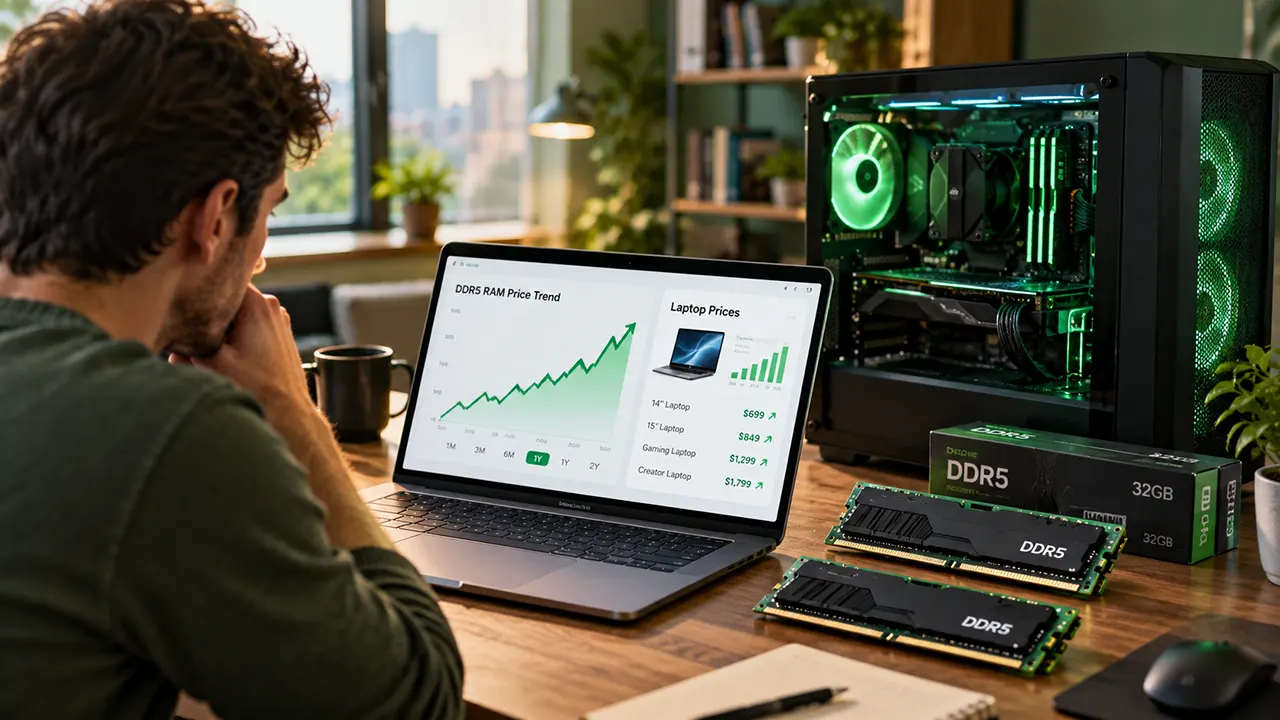
The RAM shortage in 2026 is affecting more than PC builders. Rising memory costs are also pushing up the price of laptops, desktops, and other electronics.
The main reason is the rapid growth of artificial intelligence infrastructure. AI data centers need huge amounts of high-performance memory, especially high-bandwidth memory (HBM). Because HBM and conventional DRAM compete for manufacturing capacity, increasing HBM production can tighten the supply of the RAM used in everyday computers.
Samsung said in September 2026 that HBM could account for nearly 30% of industry DRAM wafer capacity in 2027, compared with about 20% currently. The company also said HBM and standard DRAM compete for the same wafer capacity.
That creates a difficult situation for consumers: RAM prices are high, laptop prices are rising, and there is no clear date when the market will fully return to normal.
So, should you buy RAM now or wait? And is 2026 a good time to buy a laptop?
Here is what you need to know.
What Is Causing the RAM Shortage in 2026?
The current RAM shortage is largely a supply-and-demand problem.
AI infrastructure has created enormous demand for memory. Modern AI accelerators use HBM to move large amounts of data quickly between processors and memory. Manufacturers such as Samsung, SK hynix, and Micron are therefore putting significant resources into higher-margin AI memory.
The problem is that manufacturing capacity is not unlimited.
HBM is a type of DRAM, and producing more HBM can compete with production of conventional DRAM used in PCs, laptops, servers, and other devices.
Samsung’s latest comments highlight this connection. The company expects HBM to consume nearly 30% of industry DRAM wafer capacity in 2027.
This does not mean that AI companies are literally buying all consumer RAM. Instead, the semiconductor industry is allocating scarce manufacturing capacity toward products where demand and margins are particularly strong.
That leaves less flexibility for conventional memory products.
AI Is Changing the Memory Market
The situation is different from a traditional short-term component shortage.
The industry is simultaneously dealing with:
- Rapid AI data-center expansion
- Strong HBM demand
- Limited memory manufacturing capacity
- Higher server memory requirements
- Increasing enterprise storage demand
- High demand for advanced memory products
- Long-term supply agreements
- Consumers reaching their affordability limits
TrendForce reported that memory suppliers continued prioritizing AI and server applications while conventional DRAM remained tight in 2026.
This is why the current crisis can affect an ordinary person buying a 16GB or 32GB RAM kit even though that person has nothing to do with AI.
Why Are DDR5 Prices So High in 2026?
DDR5 price increases are one of the clearest consumer effects of the memory shortage.
DDR5 is the current mainstream memory standard for many new desktop and laptop systems. When upstream DRAM becomes more expensive or harder to obtain, those costs eventually reach memory-module manufacturers, PC makers, and consumers.
The increase has been dramatic in some parts of the market.
XMG, a gaming laptop and workstation manufacturer, recently said DDR5 SO-DIMM costs had increased roughly sixfold compared with July 2025. The company also cited higher SSD, PCB, CPU, GPU, and other component costs when explaining laptop price increases.
Desktop RAM has also experienced extreme price increases. Tom’s Hardware reported in August 2026 that some memory products had risen hundreds of percent compared with prices from a year earlier.
However, consumers should be careful when interpreting individual RAM prices.
A specific 32GB or 64GB kit can have a very different price depending on:
- Speed
- Timings
- Capacity
- Number of modules
- Brand
- RGB lighting
- Desktop DIMM vs. laptop SO-DIMM
- Retailer
- Availability
- Contract versus spot pricing
Therefore, there is no single DDR5 price that represents the entire market.
Why RAM Prices Can Stop Rising Without Falling
This is an important distinction.
TrendForce projected conventional DRAM contract prices to increase 13% to 18% quarter over quarter in Q3 2026. That was slower than the extraordinary increases seen earlier in the year, but it did not mean prices were falling.
In other words:
Slower price growth ≠ lower prices.
RAM can become more stable while remaining much more expensive than it was before the shortage.
That distinction matters if you are waiting for a return to older DDR5 prices.
Why Are Laptop Prices Increasing in 2026?
The RAM shortage is becoming a laptop problem because memory is part of the bill of materials for almost every modern computer.
When manufacturers pay more for memory, they have several choices:
- Increase the retail price.
- Reduce their profit margin.
- Use cheaper components elsewhere.
- Offer less RAM in the base configuration.
- Change the product configuration.
- Delay or cancel certain configurations.
Some manufacturers are already passing higher component costs to buyers.
XMG recently announced laptop price increases of up to €300 for certain models and attributed the changes to higher component costs, including dramatically more expensive DDR5 SO-DIMM memory.
Qualcomm executives have also acknowledged that laptop manufacturers are trying to balance rising component costs with consumer price expectations. One potential approach is changing other components, such as choosing LCD rather than more expensive OLED displays, to maintain target price points.
That means a laptop price increase is not necessarily caused by RAM alone.
RAM is one part of a broader component-cost problem.
How the RAM Shortage Affects Cheap Laptops
Budget laptops can be particularly vulnerable.
A premium laptop has more room to absorb a component-cost increase because the total selling price is already high.
A low-cost laptop has much less room.
For example, if memory costs increase by $50, that is a much bigger percentage of a $500 laptop than a $2,000 laptop.
Manufacturers may therefore respond by:
- Reducing base RAM
- Using older components
- Offering fewer configurations
- Increasing prices
- Removing promotions
- Switching display or storage configurations
This is one reason the RAM shortage could have a bigger impact on the entry-level PC market than on expensive flagship systems.
How Long Will the RAM Shortage Last?
There is no reliable exact end date for the RAM shortage.
Current industry signals suggest that memory supply could remain tight well beyond 2026.
Samsung said HBM is expected to consume nearly 30% of industry DRAM wafer capacity in 2027.
Earlier in 2026, Samsung and SK hynix warned that significant memory shortages could continue through at least 2027, according to reporting summarized by Tom’s Hardware.
There are also signs that major memory manufacturers have been allocating future capacity well in advance.
However, forecasts differ.
Acer CEO Jason Chen recently argued that memory suppliers’ warnings about extremely long shortages may be overstated. He expects PC prices to remain pressured through late 2026, potentially stabilize in early 2027, and decline later if new production capacity comes online.
So the most responsible answer is:
The RAM shortage is likely to remain a problem through at least part of 2027, but the timing and size of any price recovery are uncertain.
That is more useful than claiming that RAM prices will definitely crash or remain high for a specific number of years.
Will RAM Prices Go Down in 2026?
They could, but a major decline is not the most reliable expectation for the immediate future.
Several things would have to improve:
- DRAM production would need to increase.
- HBM supply would need to expand.
- AI memory demand would need to stabilize.
- Consumer demand would need to weaken enough to reduce competition for supply.
- New manufacturing capacity would need to become productive.
- Suppliers would need to allocate more capacity to conventional DRAM.
The encouraging sign is that price growth has already shown signs of moderation.
TrendForce said consumer buyers were reaching their affordability limits, which was helping moderate the pace of memory price increases.
But that does not necessarily mean RAM is becoming cheap.
A more realistic progression is:
Rapid price increases → slower increases → stabilization → eventual decline
The market may need to reach stabilization before consumers see meaningful price reductions.
Is the RAM Shortage Getting Better?
Not in the sense that consumers can assume the crisis is over.
Some price increases have moderated, but supply remains tight.
TrendForce reported that suppliers continued prioritizing AI and server applications while conventional DRAM remained undersupplied.
At the same time, current industry comments suggest that additional manufacturing capacity could eventually improve the situation.
So it is better to think of the market as changing, rather than simply getting better or worse.
The rate of price increases can decline while the underlying shortage remains.
Is the RAM Crisis Ending?
Not yet.
There are some signs of demand resistance. Consumers and PC manufacturers cannot absorb unlimited price increases.
But the fundamental AI-driven demand for memory remains strong.
Samsung’s latest capacity forecast is a good example. If HBM takes an increasing share of DRAM wafer capacity in 2027, conventional memory supply can remain under pressure even if consumer demand weakens.
The crisis will be closer to an end when supply growth consistently exceeds demand growth and inventory levels begin rebuilding.
Will the RAM Shortage Last Into 2027?
There is a meaningful possibility that it will.
Several major industry warnings point toward continued tightness into 2027.
Samsung and SK hynix have previously warned about significant shortages extending through at least 2027, while current reports continue to describe tight memory allocation.
At the same time, Acer’s CEO expects new capacity to eventually ease the situation, with potential price declines later in 2027.
That gives consumers two possible scenarios:
Scenario 1: Extended shortage
AI demand stays extremely strong, HBM consumes more capacity, and conventional DRAM remains expensive.
Scenario 2: Gradual normalization
New capacity arrives, AI memory supply improves, and DRAM prices stabilize before eventually falling.
The second scenario would be better for consumers, but there is not enough evidence to guarantee when it will happen.
Should You Buy RAM Now or Wait?
There is no universal answer.
Your decision should depend on whether you need the RAM or simply want to upgrade.
Buy RAM now if:
- Your computer is running out of memory.
- Applications are frequently using nearly all available RAM.
- You need the upgrade for work or school.
- You are building a PC soon.
- Your current RAM is incompatible with the system you need to build.
- A reputable retailer offers a genuinely good price.
If the computer is unusable because of insufficient RAM, waiting several months for a possible price decline may not be worth it.
Wait if:
- Your current PC works well.
- You are upgrading mainly because you want more RAM.
- Your system already has enough memory for your workload.
- You expect to replace the entire PC soon.
- The RAM price is substantially above your budget.
The important point is not to panic-buy.
A shortage does not automatically mean every RAM kit available today is a good deal.
Should You Buy a Laptop Now or Wait?
This depends on your need.
Buy a laptop now if you need one
If your current laptop is failing, you need a computer for work or school, or you have a time-sensitive requirement, waiting indefinitely for lower prices may not make sense.
The memory situation is uncertain, and current manufacturers are already dealing with higher component costs.
In this situation, focus on value rather than simply waiting for the market to return to normal.
Wait if your current laptop is still good
If your existing laptop handles your work comfortably, you may have more flexibility.
Waiting gives you the option to:
- Watch prices
- Compare generations
- Look for clearance deals
- Consider refurbished models
- Wait for new memory capacity to enter the market
You also avoid paying a shortage premium simply because you do not urgently need a new machine.
What Is the Best Time to Buy a Laptop in 2026?
There is no single guaranteed cheapest day to buy a laptop.
Traditional sales periods such as Black Friday, Cyber Monday, back-to-school promotions, and holiday sales can still create discounts.
However, the memory shortage complicates the normal seasonal pattern.
If manufacturers are paying substantially more for RAM and other components, a retailer may offer a discount on one model while another model becomes more expensive.
That means the best strategy is to track the actual configuration and price, rather than assuming a particular month will always be cheapest.
Look for these opportunities
- Previous-generation laptops
- Clearance inventory
- Refurbished business laptops
- Open-box models
- Upgradeable laptops
- Retailer-specific promotions
- Seasonal sales
- Models with enough RAM for your expected lifespan
A discounted previous-generation laptop can sometimes be a better purchase than a newer model with an inflated memory configuration.
What Laptop Should You Stay Away From in 2026?
Avoid buying a laptop based only on a low sticker price.
Pay particular attention to:
- 8GB RAM configurations that cannot be upgraded
- Very low-end processors paired with premium prices
- Soldered memory with insufficient capacity
- Poor cooling systems
- Weak displays when you need the laptop for long work sessions
- Limited storage
- Devices with no practical upgrade path
During a memory shortage, upgradeability can become more valuable.
A laptop that allows you to add or replace memory gives you more flexibility than one permanently limited to a small amount of soldered RAM.
What Is the Most Reliable Laptop Brand in 2026?
There is no single laptop brand that is automatically the most reliable for every buyer.
Reliability depends on:
- Specific model
- Build quality
- Cooling
- Battery design
- Repairability
- Parts availability
- Warranty
- Customer support
- Intended workload
Instead of choosing a brand solely because it has a good reputation, research the exact model you plan to purchase.
For a long-term purchase, also check whether the RAM is upgradeable and whether the SSD can be replaced.
How Much Should a Decent Laptop Cost in 2026?
There is no universal price that defines a decent laptop.
Your budget should depend on your workload.
Basic use
For web browsing, documents, email, video streaming, and light productivity, you do not necessarily need an expensive machine.
Productivity
For heavier office work, multitasking, programming, content creation, and large browser workloads, prioritize:
- Adequate RAM
- A capable CPU
- Fast SSD storage
- Good cooling
- A comfortable display
Gaming and professional workloads
Gaming, video editing, 3D work, engineering applications, and other demanding workloads can require significantly more expensive hardware.
The key lesson during the RAM shortage is simple:
Buy the configuration you actually need rather than paying a shortage premium for unnecessary specifications.
Is 2026 a Good Time to Buy a New PC?
For someone who needs a PC, 2026 can still be a reasonable time to buy.
For someone who simply wants the newest hardware, waiting may be more attractive.
The decision becomes easier if you separate need from desire.
Buy now when:
- Your current PC is failing.
- You need substantially more performance.
- Your work depends on a faster system.
- You find a strong deal.
- You need a specific configuration.
Wait when:
- Your existing PC performs well.
- You are buying only for a minor performance improvement.
- Your budget is tight.
- You can comfortably wait for memory prices to stabilize.
What Could End the RAM Shortage?
Several developments could eventually relieve the pressure.
More DRAM capacity
Additional production capacity would increase conventional memory supply.
More HBM capacity
If manufacturers can satisfy AI customers with expanded HBM production, there could be less pressure on other DRAM capacity.
Slower AI infrastructure growth
If data-center expansion slows, memory demand could become easier for manufacturers to satisfy.
New memory manufacturers and capacity
New sources of memory production could increase competition and supply.
Demand destruction
Very high prices can eventually reduce demand.
This is already happening to some degree. TrendForce said consumer buyers were reaching affordability limits in 2026, contributing to slower price growth.
But demand destruction is not the same as solving the shortage.
It simply means buyers are becoming less willing or able to purchase at higher prices.
What Should PC Buyers Do During the RAM Crisis?
The best strategy is to avoid both extremes:
Do not panic-buy.
Do not assume prices will immediately collapse.
Instead, match your purchase to your actual need.
| Your situation | Best approach |
|---|---|
| Current PC works well | Wait if the upgrade is optional |
| PC needs more RAM for work | Upgrade when you find a reasonable price |
| Building a PC soon | Compare complete build costs now |
| Laptop needed immediately | Buy a good-value configuration |
| Old upgradeable laptop | Compare RAM upgrade vs. replacement |
| Laptop has soldered 8GB RAM | Think carefully before buying |
| Budget is tight | Consider previous-generation/refurbished hardware |
| You can wait 6–12 months | Monitor prices and capacity trends |
Will RAM Ever Be Affordable Again?
Yes, but “affordable” does not necessarily mean returning to the lowest prices seen before the shortage.
Memory is a cyclical industry.
Periods of oversupply can push prices down, while periods of strong demand and constrained production can send them sharply higher.
The current cycle is unusual because AI infrastructure has created an enormous new source of memory demand.
If manufacturing capacity eventually catches up, prices should become more competitive.
The difficult question is when.
Current evidence does not justify promising consumers a specific month when RAM prices will return to old levels.
Where Is the Best Place to Buy RAM Right Now?
The best retailer depends on the specific RAM kit, price, return policy, warranty, and availability.
For a US buyer, compare several reputable retailers rather than purchasing from the first seller that has stock.
Check:
- Total delivered price
- Warranty
- Return policy
- Seller reputation
- Exact RAM specification
- Compatibility
- Capacity
- Speed
- Timings
Most importantly, compare the price per GB and the complete specification, not just the headline price.
A cheaper kit may have lower capacity or performance.
The Bottom Line on the RAM Shortage 2026
The RAM shortage in 2026 is real, but it is more complicated than simply saying there is not enough RAM.
The bigger story is the competition for semiconductor manufacturing capacity.
AI infrastructure is creating enormous demand for HBM. HBM and conventional DRAM share manufacturing resources, and Samsung expects HBM to account for nearly 30% of industry DRAM wafer capacity in 2027.
At the consumer level, that pressure is showing up as:
- Higher DDR5 prices
- Higher laptop memory costs
- Higher PC component costs
- More expensive laptop configurations
- Reduced affordability
- More uncertainty about the best time to buy
There are also reasons for cautious optimism. Memory price growth has begun to moderate in some segments as consumers reach affordability limits, and additional production capacity could eventually improve supply.
But buyers should not count on a rapid return to old prices.
If you need RAM now, buy what you need at a reasonable market price. If your system works well, waiting gives you more flexibility. If you need a laptop, focus on total value and upgradeability rather than simply trying to predict the bottom of the market.
The most important thing is to avoid making a major purchase based on fear.
RAM Shortage 2026 FAQ
How long will the RAM shortage last?
There is no confirmed end date. Current industry warnings indicate that memory supply could remain tight into 2027, although some manufacturers expect new capacity to eventually improve conditions.
Will RAM prices go down in 2026?
They may stabilize or decline in some segments, but a major price drop is not guaranteed. TrendForce expects conventional DRAM prices to continue rising in Q3 2026, although at a slower rate than earlier in the year.
Why is there a RAM shortage now?
The main structural driver is strong AI and data-center demand. Manufacturers are allocating substantial capacity to HBM and other high-value memory products, putting pressure on conventional DRAM supply.
Why are DDR5 prices so high?
DDR5 prices are being affected by tight DRAM supply, strong AI/server demand, manufacturing-capacity allocation, and higher upstream costs. Some laptop DDR5 SO-DIMM prices have risen dramatically compared with 2025.
Is the RAM shortage getting better?
The rate of price increases has moderated in some areas, but that does not mean the shortage is over. Conventional DRAM remains under supply pressure.
Is the RAM crisis ending?
Not yet. The market remains tight, and major memory manufacturers continue to prioritize AI-related demand.
Will the RAM shortage last into 2027?
It may. Samsung and SK hynix have previously warned about shortages extending into 2027, while other industry executives expect new capacity to improve the situation later.
Should I buy RAM now or wait?
Buy now if you need the RAM for work, school, gaming, or a PC build. If your current system works well and the upgrade is optional, waiting gives you more flexibility.
Should I buy a laptop now or wait?
If you need a laptop, buying a good-value configuration can make sense because component costs remain uncertain. If your current laptop works well, waiting can give you more opportunities to compare prices and newer configurations.
Will RAM ever be affordable again?
RAM should eventually become more affordable if supply catches up with demand, but there is no reliable date for a return to previous price levels. The AI-driven memory market has changed the supply-demand balance significantly.

Belayet Hossain is a Senior Tech Expert and Certified AI Marketing Strategist. Holding an MSc in CSE (Russia) and over a decade of experience since 2011, he combines traditional systems engineering with modern AI insights. Specializing in Vibe Coding and Intelligent Marketing, Belayet provides forward-thinking analysis on software, digital trends, and SEO, helping readers navigate the rapidly evolving digital landscape. Connect with Belayet Hossain on Facebook, Twitter, Linkedin or read my complete biography.