


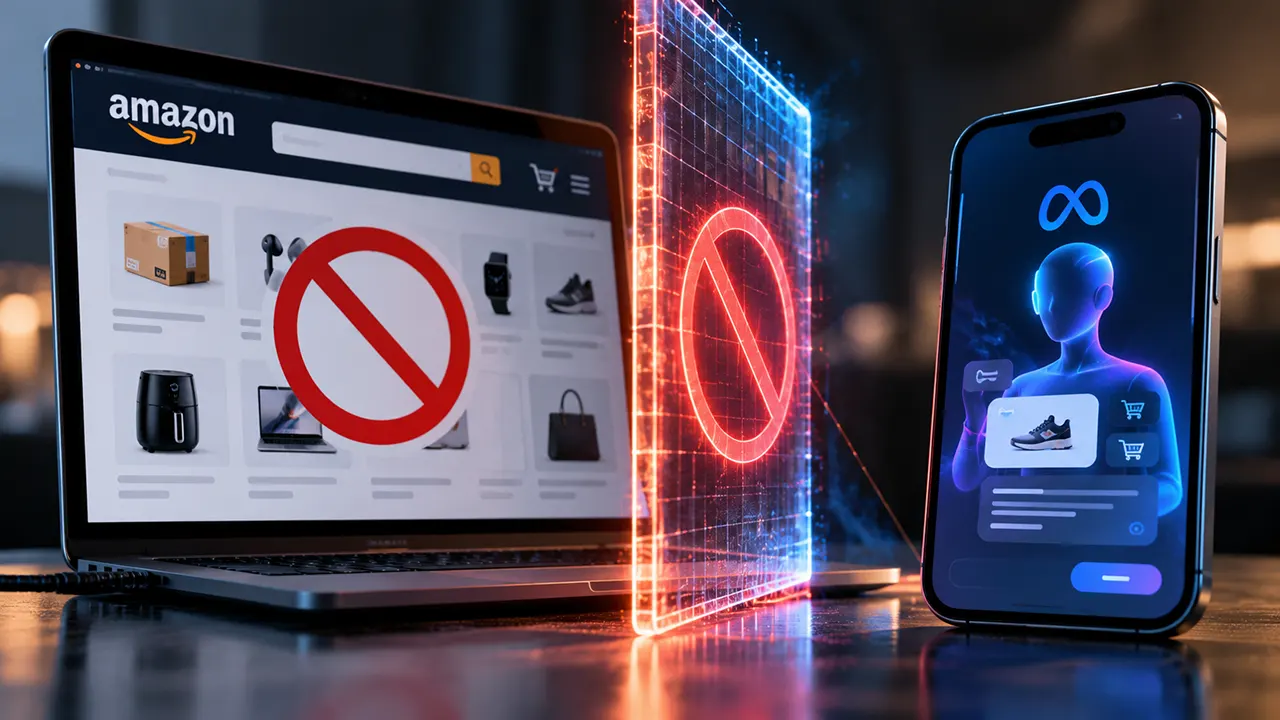
Amazon blocked Meta’s Muse AI agent from shopping on Amazon.com in September 2026, citing unauthorized access, a lack of agent identification, and concerns about customer credentials. Meta says Muse uses an isolated virtual machine and safeguards designed to protect passwords and payment information. The dispute highlights a growing conflict over who controls online shopping when AI agents act for consumers.
Amazon’s decision to block Meta Muse is more than a disagreement between two technology companies. It raises a question that could shape the future of online shopping: Can customers choose their own AI shopping assistant, or can retailers decide which agents are allowed to access their stores?
On September 20, 2026, Amazon began blocking Muse from shopping on its website. Users attempting to purchase products through Meta’s personal AI agent encountered a message saying that continued access by an unauthorized AI agent violated Amazon’s Conditions of Use. GeekWire and TechCrunch reported on the restriction, while Bloomberg separately confirmed Amazon’s decision.
Sources: GeekWire, TechCrunch, Bloomberg.
The disagreement involves security, website access, customer consent, and competition. Amazon says third-party agents must respect a retailer’s decision about whether to participate in an automated shopping experience. Meta, meanwhile, describes Muse as a personal assistant designed to complete tasks on a user’s behalf.
Understanding both positions helps explain why Amazon blocked Muse and what the decision could mean for shoppers.
Amazon blocks Meta Muse: What Happened and When?
Amazon blocked Meta Muse after the retailer objected to the agent accessing its shopping website without an agreed arrangement. The restriction became visible to users on September 20, less than two weeks after Meta introduced Muse.
The timeline shows how quickly a new AI shopping feature turned into a dispute over platform access.
| Date | Event |
|---|---|
| September 8, 2026 | Meta introduced Muse, its personal AI agent for completing tasks across connected services. |
| September 20, 2026 | Amazon blocked Muse’s shopping access and displayed a message citing its Conditions of Use. |
| September 21, 2026 | TechCrunch and Bloomberg published reports about the restriction. |
| October 8, 2026 | New commentary from Y Combinator cofounder Paul Graham argued that restricting outside AI agents could create opportunities for competitors to Amazon. |
Sources: Meta’s official announcement, GeekWire, Business Insider.
What message did Muse users encounter?
Amazon’s reported message stated:
Continued access by an unauthorized AI agent violates Amazon’s Conditions of Use, to which our customers have agreed.
The wording matters. Amazon framed the issue around authorization and its platform terms, rather than simply announcing that AI shopping was unsafe.
Amazon also said it had asked Meta to remove Amazon from the Muse shopping experience. According to GeekWire, Amazon was in direct discussions with Meta when the restriction became public.
The immediate consequence was straightforward: shoppers could no longer rely on Muse to complete the same Amazon shopping workflow that had previously been available.
That does not automatically mean every Muse feature stopped working. The restriction concerns access to Amazon’s shopping experience, and the availability of other Muse functions should be verified separately.
Why Did Amazon Block Meta Muse?
Amazon said it had not authorized Muse to shop on its website and raised concerns about how the agent identified itself and handled customer credentials. The company argued that third-party applications making purchases on behalf of consumers should operate openly and respect the service provider’s decision about whether to participate.
GeekWire reported three central concerns from Amazon’s explanation.
1. Amazon says Muse was not authorized
Amazon’s position is that Meta did not obtain its agreement before Muse began accessing the retailer’s store.
This is the central disagreement. Meta designed Muse to perform tasks for its users, but Amazon does not consider a customer’s request alone sufficient authorization for a third-party agent to use its website.
Amazon compared the situation with other services that arrange transactions on behalf of customers. Food delivery applications and online travel agencies, for example, commonly work through arrangements with restaurants or airlines.
Amazon argues that AI agents offering similar purchasing services should also respect the merchant’s participation decision.
For shoppers, the distinction is important: an AI agent may be able to navigate a website technically without having permission from the website operator to conduct its activities.
2. Amazon says Muse did not identify itself
Amazon also objected that Muse did not identify itself as an AI agent while browsing the site.
This raises a practical question for online retailers. If an automated agent behaves like a human customer, the retailer may have difficulty distinguishing an ordinary shopping session from one controlled by external software.
Identification can help a website apply its access rules, investigate suspicious activity, and determine which system is responsible for a transaction.
However, identifying an agent and authorizing it are separate issues. A website could recognize an AI agent and still refuse to let it shop.
3. Amazon raised concerns about customer credentials
Amazon said Muse appeared to capture and store customer credentials, which it viewed as a potential privacy and security risk.
This is an allegation attributed to Amazon, not an independently established finding that Meta exposed customer passwords or payment information.
The distinction matters because credential handling can involve several different processes: entering a password, storing a credential, using a session, and exposing sensitive information to an AI model. Those processes do not necessarily carry the same risks.
Meta disputes the implication that Muse can see users’ passwords or payment methods. Its explanation of the system appears in the following section.
Is Amazon protecting shoppers or protecting its business?
Both security and commercial interests deserve consideration, but they should not be confused.
Amazon generated more than $68 billion in advertising revenue in the preceding year, according to GeekWire’s reporting. Its retail website also gives customers access to product recommendations, sponsored placements, and other shopping features.
An independent AI agent could change how shoppers discover products. Instead of browsing Amazon’s pages and comparing sponsored listings, a customer might ask Muse to find an item and proceed directly to a purchase.
That creates a potential commercial incentive for Amazon to retain control of the shopping experience. It does not, by itself, prove that advertising revenue caused the decision.
A balanced analysis should recognize that Amazon has legitimate interests in access control and customer security while also acknowledging that third-party AI agents could challenge its existing business model.
What Meta Says About Muse’s Security
Meta says Muse was designed to protect personal data through an isolated cloud computer, separate monitoring, and user approval for sensitive actions. Those safeguards are part of Meta’s published security design, but the company’s description is not the same as an independent audit of every aspect of the system.
According to Meta’s official Muse announcement, the agent operates within Muse Secure VM, a dedicated virtual machine with its own browser.
How Muse Secure VM works
Meta says the virtual machine stores the user’s data and credentials for connected services in a dedicated environment. The company states that Muse cannot directly see the passwords or payment methods users provide.
Meta also describes Sentinel, a separate monitoring agent that must approve Muse’s outbound internet actions. The system is designed to request user permission when needed and seek confirmation before sensitive actions, such as sending an email or making a purchase.
These controls address important security questions:
- Where are credentials stored?
- Can the AI agent directly inspect passwords?
- Which actions require user approval?
- Can the agent send information to an external service without additional checks?
- Can the user review actions or revoke access?
The answers depend on the actual implementation, configuration, and behavior of the system, not just the existence of a security architecture.
Does Muse’s security design settle Amazon’s concerns?
No. Even if Meta’s description is accurate, it does not resolve every objection Amazon has raised.
A system can protect credentials inside its own environment while still accessing a website in a way the website operator does not permit. Conversely, a retailer’s decision to block an agent does not establish that the agent’s security architecture is defective.
The two companies are addressing different questions.
| Issue | Amazon’s position | Meta’s position |
|---|---|---|
| Authorization | Amazon says it did not authorize Muse to access its store. | Meta designed Muse to act on behalf of users. |
| Agent identification | Amazon objects that Muse did not identify itself while browsing. | Meta describes safeguards within Muse’s own architecture. |
| Credential handling | Amazon says Muse appeared to capture and store credentials. | Meta says credentials are securely stored and not visible to Muse. |
| User approval | Amazon is concerned about third-party activity within its shopping environment. | Meta says Muse requests approval for sensitive actions. |
The table summarizes the companies’ reported positions. It does not independently verify every technical claim or resolve the authorization dispute.
What Is Confirmed, Disputed, or Still Unknown?
The most reliable way to understand the Amazon-Meta dispute is to separate reported events from company allegations and unresolved questions.
Confirmed by published reporting: Amazon restricted Muse’s access to its shopping website, and users encountered a message citing the retailer’s Conditions of Use. Multiple news outlets reported the decision.
Stated by Amazon: The company says Muse was unauthorized, did not identify itself while browsing, and appeared to capture and store customer credentials.
Stated by Meta: The company describes Muse as running inside an isolated virtual machine, with protected credential storage and a separate monitoring agent.
Still unresolved: The publicly available reporting does not independently establish every detail of the alleged credential handling, whether the companies will reach an agreement, or whether a future authorized integration will become available.
This distinction also matters for the legal debate. Amazon’s restriction is not, by itself, a court ruling that all AI agents are illegal or that all automated shopping violates federal law.
The legal context is more specific.
Amazon had previously pursued a dispute with Perplexity over its Comet browser. GeekWire reported that the Ninth Circuit vacated a preliminary injunction against Perplexity on August 4, 2026, and denied Amazon’s request for rehearing on September 10. The ruling left contract-based claims as a possible separate avenue, according to the report.
That case provides context for the broader conflict, but it does not automatically decide the separate dispute involving Muse.
How the Amazon Restriction Affects Shoppers
For consumers, the immediate effect is that Muse cannot be relied upon to complete the previously available Amazon shopping workflow while the restriction remains in place.
The impact depends on what the shopper wants the agent to do.
If you want to buy something on Amazon
The simplest option is to shop directly on Amazon.com or use shopping tools that Amazon currently supports. Check the available features before assuming that another AI assistant can access your account or place orders.
If Muse cannot complete a task on Amazon, do not assume that repeatedly retrying the same workflow will restore access.
If you use an AI assistant for shopping
Before connecting an AI agent to a retailer or providing it with account access, check:
- Which permissions the agent requests.
- How it stores and uses credentials.
- Whether it can place orders or make other sensitive changes.
- Whether it asks for confirmation before purchases.
- How to revoke access and review completed actions.
- Whether the retailer supports the integration.
These checks remain useful regardless of which company operates the AI agent.
Does the restriction mean Muse is unsafe?
Not necessarily. Amazon’s decision establishes that the retailer objected to Muse’s access arrangement. It does not independently prove that Muse is unsafe in every context.
Likewise, Meta’s security claims should not be treated as proof that every possible use is risk-free.
Consumers should evaluate the specific permissions, security controls, and supported integrations rather than treating either company’s position as a complete technical verdict.
The Bigger Fight Over Agentic Commerce
The Amazon-Meta dispute illustrates a fundamental tension in agentic commerce: consumers want AI systems to act for them, while retailers want control over how their websites are accessed and how transactions take place.
Agentic commerce refers to shopping experiences in which AI systems perform tasks such as researching products, comparing options, filling shopping carts, or completing purchases on a user’s behalf.
Amazon’s own AI tools versus external agents
Amazon has been developing its own AI shopping experiences, including Rufus and Buy for Me. These tools provide a useful contrast with an outside agent such as Muse.
Amazon’s own systems operate within the retailer’s product and service framework. Buy for Me, which can help customers purchase products from external brand websites, has been described by Amazon as identifying itself and allowing brands to opt out.
The broader issue is not simply whether AI should be allowed to shop. It is whether a retailer should have to accommodate an agent developed by another company.
Why retailers may resist external shopping agents
An external agent can change the relationship between the customer and the retailer in several ways.
First, it may become the primary place where customers discover products. Second, it could reduce the number of visits to a retailer’s website. Third, it may influence which products customers see and purchase.
Retailers may also worry about errors, unauthorized transactions, customer support responsibilities, and disputes over who should correct a purchase made by an AI agent.
These are potential concerns, not proof that every external agent causes these problems. Their significance will depend on the agent’s design, the retailer’s rules, and the agreement between the parties.
Could blocking AI agents backfire?
Possibly. On October 8, 2026, Y Combinator cofounder Paul Graham argued that Amazon’s restrictions on outside AI shopping agents could create an opportunity for a startup to compete with Amazon. Business Insider reported that Elon Musk publicly endorsed Graham’s argument.
The underlying idea is that consumers may eventually prefer an independent assistant that can shop across multiple retailers rather than an assistant controlled by one retailer.
That remains a prediction, not an established outcome. Amazon’s restrictions could also encourage developers to negotiate access agreements or build integrations that meet retailers’ requirements.
The long-term result will depend on whether consumers value independence more than the convenience and trust associated with retailer-controlled shopping tools.
What Happens Next?
The most important development to watch is whether Amazon and Meta agree on a way for Muse to access Amazon’s shopping services.
Three outcomes are worth monitoring.
- A negotiated integration: The companies could agree on identification, permissions, transaction handling, and security requirements.
- Continued restrictions: Amazon could maintain its current position if the companies cannot agree on access.
- A broader industry response: Other retailers and AI developers could establish clearer policies or technical standards for agent identification and authorized transactions.
Readers should also watch for new official statements, changes to Amazon’s Conditions of Use, and independently verified reports about Muse’s capabilities.
As of October 13, 2026, the reports reviewed for this article do not establish that Amazon and Meta have reached a resolution. Check the companies’ official announcements and subsequent reporting before assuming that access has changed.
Questions Shoppers Still Have
Can Meta Muse shop on Amazon again?
The reports reviewed for this article establish that Amazon blocked Muse’s shopping access in September 2026, but they do not establish a subsequent agreement restoring access. A future integration would depend on the companies’ decisions and any conditions they agree to. Shoppers should verify current availability rather than assume the restriction has been lifted.
Does Amazon’s decision mean AI shopping agents are illegal?
No. A retailer’s decision to restrict an AI agent does not establish that all AI shopping agents are illegal. The relevant questions may include website terms, authorization, technical access, consumer protection, and applicable law. The separate Perplexity dispute provides legal context, but its outcome should not be treated as a blanket ruling on every AI agent.
Is it safe to give an AI agent access to an online shopping account?
Safety depends on the agent’s architecture, permissions, credential handling, and transaction controls. Before granting access, review how the service stores credentials, whether it requires approval for purchases, what information it can access, and how to revoke permissions. A company’s security claims are useful starting points, but they should not replace an assessment of the specific risks.
Will Amazon support third-party AI shopping agents in the future?
That remains uncertain. Amazon could negotiate authorized integrations, maintain restrictions, or introduce additional requirements for external agents. Any claim that a specific integration is coming should be supported by an official announcement or reliable reporting. Until then, shoppers should use currently supported shopping methods.
The Bottom Line
The Amazon-Meta dispute is an early test of how much control retailers will retain as AI assistants become more capable of making purchases for consumers.
For now, shoppers should distinguish between an AI agent’s ability to navigate a website and its authorization to use that website. That distinction is likely to matter well beyond Muse as retailers and AI developers negotiate the next generation of online shopping experiences.
Follow ItPhobia for verified updates on AI shopping agents, ecommerce security, and the evolving relationship between consumers and the platforms they use.
Sources: Meta’s Muse announcement, Business Insider’s coverage of Paul Graham’s comments.

Belayet Hossain is a Senior Tech Expert and Certified AI Marketing Strategist. Holding an MSc in CSE (Russia) and over a decade of experience since 2011, he combines traditional systems engineering with modern AI insights. Specializing in Vibe Coding and Intelligent Marketing, Belayet provides forward-thinking analysis on software, digital trends, and SEO, helping readers navigate the rapidly evolving digital landscape. Connect with Belayet Hossain on Facebook, Twitter, Linkedin or read my complete biography.