


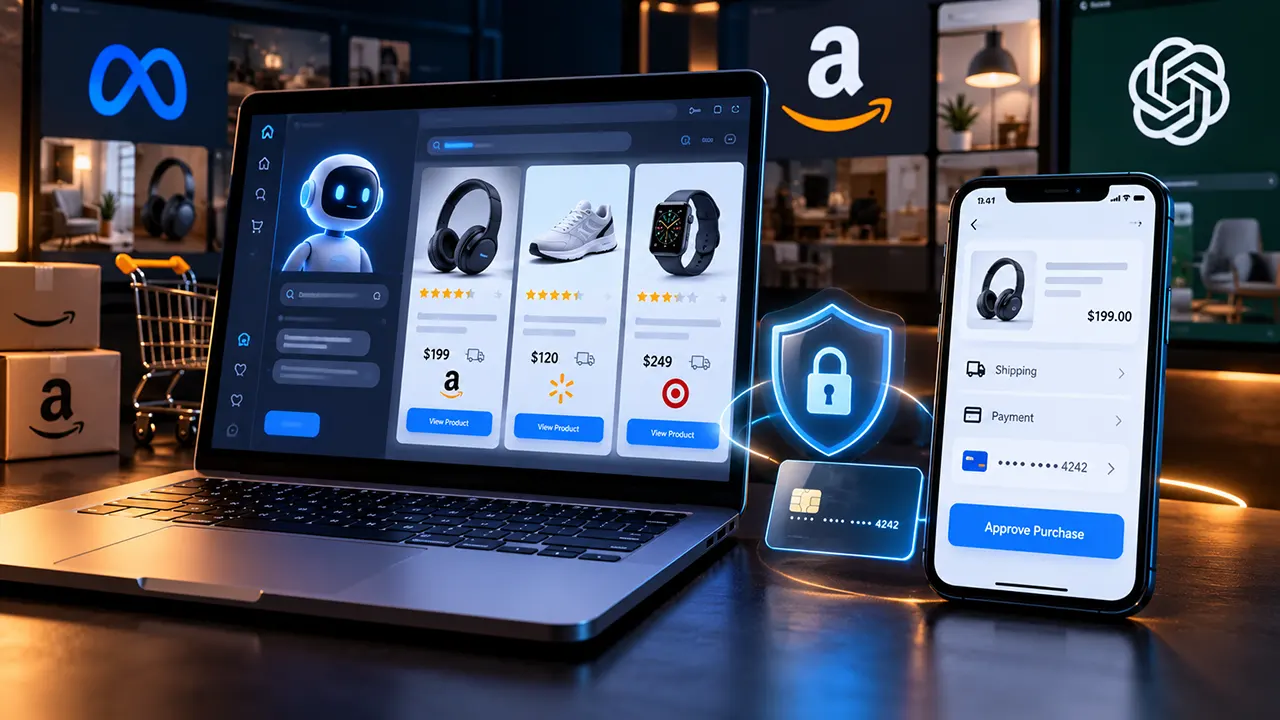
Agentic shopping uses AI agents to research products, compare options, monitor prices, and sometimes complete purchases on a shopper’s behalf. Unlike a basic shopping chatbot, an agent can take actions across multiple steps. However, its actual purchasing power depends on user permissions, retailer access, supported payment systems, and the checkout rules of each service.
Shopping online may soon involve less searching and more delegation. Instead of opening ten product pages, you might ask an AI agent to find a desk lamp under $50, compare its features, check delivery dates, and prepare an order.
That sounds simple, but an important question follows: When should an AI agent act independently, and when should it stop and ask you?
In 2026, that question matters as Meta, Amazon, and OpenAI develop different approaches to AI-powered shopping. Understanding the differences can help you save time without handing over more control than you intended.
What Is Agentic Shopping in 2026?
Agentic shopping is a form of ecommerce in which AI agents perform shopping tasks with some degree of independence. Depending on the system, these tasks can include product research, price comparisons, cart preparation, checkout, and post-purchase assistance.
Traditional online shopping requires you to perform most actions yourself. A conventional AI assistant may recommend products, but an agent can go further by using a browser, interacting with supported services, and carrying out a multi-step task.
For example, you could ask an agent to find an ergonomic office chair under $250. It might compare seat adjustments, dimensions, seller ratings, shipping costs, and return policies before presenting suitable options.
Whether it can then buy the chair is a separate question. Some systems only provide recommendations. Others support checkout with approved merchants, while more advanced agents may interact with websites on your behalf.
The key distinction is delegated action, not simply intelligent recommendations.
Agentic shopping vs. agentic commerce
These terms are closely related, but they emphasize different things.
- Agentic shopping focuses on the shopper’s experience, including product research, comparisons, and purchasing.
- Agentic commerce describes the broader system connecting AI agents, consumers, retailers, payment providers, and commerce infrastructure.
- AI shopping assistant is a broader term for software that helps with shopping. It may or may not take independent actions.
- Autonomous shopping generally refers to a higher level of delegation, where an agent completes more steps with less direct input.
Agentic commerce can involve both consumer-facing assistants and the technical systems that let those assistants interact with merchants.
For consumers, the practical question is not whether a product uses the word agentic. It is what the product can actually do, which permissions it needs, and where it requires your approval.
How Do AI Shopping Agents Work From Search to Purchase?
AI shopping agents combine language models, planning, external tools, and permission controls to complete tasks that involve multiple steps. A typical workflow starts with a request, gathers information, evaluates options, and then performs only the actions allowed by the system.
Imagine asking an agent to find a quiet mechanical keyboard for a home office, with a budget of $100.
1. The agent interprets your request
The agent identifies the product type, budget, intended use, and preferences. If you mention that you share a room with someone else, it may prioritize quieter switches.
The quality of the result depends on how well the agent understands your constraints. A vague request such as “find me a good keyboard” gives it much more room to make assumptions.
2. It researches and compares products
Depending on its available tools, the agent may search product pages, read specifications, compare prices, and inspect delivery information.
It can then rank the options against your preferences. However, search coverage may be incomplete, and a product page can contain inaccurate, outdated, or misleading information.
An agent’s confidence does not guarantee that a seller has the product in stock or that a listed specification is correct.
3. It prepares the next action
The agent might create a shortlist, open a product page, add an item to a cart, or prepare checkout information.
These actions require different permissions. Reading a product page is not the same as changing a shopping cart, and changing a cart is not the same as placing an order.
4. It requests authorization when required
A well-designed purchasing workflow makes important transaction details visible before an order is placed. These can include the seller, item, quantity, final price, shipping address, and payment method.
OpenAI’s documented Instant Checkout flow, for example, asks the user to confirm order, shipping, and payment details for supported purchases.
5. The merchant processes the order
In an integrated checkout, the merchant or its payment infrastructure validates the transaction. The agent’s interface may display the result, but it does not automatically control inventory, shipping, refunds, or the merchant’s acceptance of an order.
This is why an agent can appear capable of shopping but still fail to complete a purchase.
AI Product Recommendations vs. Autonomous Shopping
The difference between an AI shopping assistant and an agent that can buy products becomes clearer when you examine each stage of the shopping journey.
| Shopping action | What it means | What to verify |
|---|---|---|
| Product discovery | Finds potentially relevant products | Search coverage and relevance |
| Product comparison | Evaluates features, prices, and sellers | Accuracy of specifications and total cost |
| Cart building | Adds selected products to a cart | Correct item, quantity, and variant |
| Checkout initiation | Prepares the order | Seller, delivery, fees, and payment details |
| Purchase completion | Submits a supported transaction | Explicit authorization and order confirmation |
| Post-purchase support | Helps track, return, or resolve an order | Actual merchant permissions and available support |
A system may support the first four actions without being able to complete the fifth. Post-purchase assistance may also require separate integrations.
A useful rule: Evaluate an agent by the highest-risk action it can perform, not by the number of tasks it can describe.
A tool that compares prices but cannot spend money has a different risk profile from one that can place orders using a stored payment method.
How Does Agentic Checkout and Payment Authorization Work?
Agentic checkout connects an AI shopping workflow to a merchant’s ordering and payment systems. The AI may prepare the transaction, but the merchant still needs to validate the order and process it through a supported payment arrangement.
The most important distinction is between permission to shop and permission to spend. An agent might be allowed to research products without being authorized to make a purchase.
What happens during AI checkout?
A supported checkout flow generally follows these steps:
- The agent identifies a product and checks the available purchasing options.
- The shopper selects the item and reviews the proposed order.
- The checkout system collects the required shipping and payment information.
- The shopper authorizes the transaction according to the system’s approval rules.
- The merchant validates the order and processes the payment.
- The system reports whether the order was accepted.
The precise sequence varies by implementation. A retailer may reject an order because of inventory, delivery restrictions, payment problems, or its own risk controls.
OpenAI’s Agentic Commerce Protocol is designed to connect AI interfaces with participating merchants. Its documentation describes product feeds, checkout sessions, merchant-side validation, and order-status responses. Participation is not universal, so this workflow should not be assumed to work with every online store.
What are payment tokens, and why do they matter?
A payment token is a substitute for sensitive payment credentials. Depending on the implementation, it can help authorize a specific transaction without exposing the underlying card number to every component involved in the process.
Some delegated payment systems can limit authorization by merchant, amount, or transaction. These restrictions can reduce exposure, but they do not guarantee that an order is correct or that fraud is impossible.
Meta’s official Muse documentation describes a checkout arrangement using Link by Stripe and a one-time-use card number intended to keep the shopper’s real card details hidden. Meta also describes purchase protections for eligible transactions. These are product-specific claims, not evidence that all AI shopping agents use the same safeguards.
Before enabling any agent to purchase products, check:
- Whether its payment authorization is limited to specific transactions.
- Whether it supports spending limits or approval requirements.
- Whether the merchant and payment provider support the workflow.
- Which transactions qualify for purchase protection.
- How to revoke permissions and report an unauthorized transaction.
Why final purchase approval matters
An agent can misunderstand a request even when it performs the technical steps correctly. It might choose the wrong size, overlook a delivery fee, or interpret a price limit as applying to the item rather than the complete order.
For that reason, the final approval screen should show the actual transaction, not merely a summary such as “I found the best deal.”
For expensive purchases, recurring orders, unfamiliar merchants, and products with complicated return terms, keeping explicit approval in the loop is a sensible default.
Why Do Retailers Restrict Third-Party Shopping Agents?
Retailers may restrict automated agents because they want to control access to their websites, protect customer accounts, manage fraud, and determine how transactions occur. A capable AI model cannot automatically bypass a retailer’s technical controls or terms.
This creates a central tension in agentic commerce. Shoppers may want one assistant to compare products across many stores, while retailers may prefer customers to use their own shopping apps and purchasing systems.
Platform lockouts are a real limitation
In October 2026, reporting on Meta’s Muse described restrictions affecting its ability to make purchases on Amazon. The dispute illustrates why an agent that can browse and interact with some websites may not be able to complete transactions everywhere.
The practical implications are significant:
- A retailer may block automated browsing or require additional verification.
- An agent may encounter a CAPTCHA or a login challenge.
- A checkout flow may require a supported merchant integration.
- Website changes can break automated interactions.
- A retailer may reject a transaction even after the agent prepares it.
A website restriction is not necessarily a technical failure in the AI model. It can be a deliberate access or authorization decision.
Why merchant authorization matters
A supported integration gives the merchant a defined way to exchange product, checkout, and order information with an AI service. It can also preserve the merchant’s role in validating transactions and handling fulfillment.
OpenAI’s Agentic Commerce Protocol is one example of this approach. It is an integration framework, not a universal permission slip that allows any agent to purchase from any retailer.
For consumers, the safest approach is to use supported purchasing flows rather than trying to work around a retailer’s access controls.
Privacy, Fraud, and Incorrect-Purchase Risks
AI shopping agents introduce risks that go beyond ordinary product recommendations because they may access personal information, interact with websites, and initiate transactions.
The level of risk depends on the agent’s permissions, technical design, payment controls, and the services it connects to. No single security feature removes every risk.
Personal information may travel across services
Shopping often involves more than a product name. An agent may need your delivery address, shopping preferences, account details, or other information to complete a task.
Before connecting an account, understand what data the agent can access, where that data is stored, and whether it can be used to improve the provider’s AI models.
Prefer tools that provide clear permission settings, a visible activity history, and an option to disconnect services. Remove access that is no longer necessary.
Incorrect purchases can happen
An agent may select the wrong product, overlook a compatibility requirement, misunderstand a quantity, or fail to notice that a displayed price excludes shipping.
Consider a simple example: you ask for two replacement filters for an air purifier. The agent finds a product that looks similar but fits a different model. The checkout may work perfectly, yet the purchase is still wrong.
Reduce this risk by checking exact model numbers, product variants, quantities, total cost, and return eligibility before authorizing the order.
Prompt injection can influence an agent
Prompt injection is an attack in which malicious content attempts to manipulate an AI system’s instructions. An agent browsing a product page could encounter text designed to persuade it to ignore the user’s constraints, reveal information, or take an unintended action.
The danger is greater when an agent has broad permissions and can act withouft asking the user at critical points.
NIST‘s work on AI agent identity and authorization highlights the importance of controlling which agents can access systems and which actions they are allowed to perform. These controls need to be combined with safeguards against malicious instructions and unsafe actions.
Payment security does not guarantee purchase safety
A tokenized payment method can reduce exposure of card credentials, but it cannot guarantee that the agent chose the correct item or that the seller will fulfill the order as expected.
Similarly, purchase protection may have eligibility requirements, exclusions, or claim deadlines. Read the actual terms rather than assuming that every transaction is covered.
If you notice an unauthorized transaction, contact your payment provider promptly and follow its reporting process. In the United States, the Consumer Financial Protection Bureau provides consumer information about fraud, scams, and financial-product complaints.
How to Use AI Shopping Agents Without Losing Control
You do not need to avoid AI shopping to use it safely. The goal is to delegate routine research while keeping meaningful control over spending, personal information, and final purchase decisions.
1. Set clear limits before delegating
Give the agent a precise request. Include your budget, required features, acceptable sellers, and any conditions that must be met.
For example:
Find a desk lamp under $50 with adjustable brightness and a physical control button. Compare at least three options. Include shipping costs and return policies. Do not place an order without my approval.
This instruction separates research from purchasing and reduces the room for unwanted assumptions.
2. Review the complete order, not just the product price
Before approving a purchase, check the following:
- Product: Correct model, size, color, and quantity.
- Seller: Correct merchant and a credible product listing.
- Total cost: Item price, shipping, taxes, and any additional fees.
- Delivery: Address, delivery date, and any special conditions.
- Returns: Return window, fees, and eligibility.
- Payment: Correct payment method and transaction amount.
A product advertised at $45 may not be the cheapest option after shipping or other charges. Compare the complete cost before making the decision.
3. Use the least powerful permission that works
An agent that only needs to compare products does not need permission to purchase them.
Use this simple permission ladder:
Level 1: Research only
Allow product discovery and comparisons. Keep all account changes and purchases manual.
Level 2: Prepare the order
Allow cart preparation or checkout assistance, but review the complete transaction yourself.
Level 3: Approved purchasing
Permit supported purchases only when the authorization rules, spending boundaries, and confirmation process are clear.
These are practical permission levels, not standardized product settings. Not every agent offers all three.
4. Monitor activity and revoke access when needed
Review order confirmations, payment notifications, and the agent’s activity log. If an agent behaves unexpectedly, stop the task, revoke unnecessary permissions, and contact the relevant merchant or payment provider.
For sensitive accounts, use available multifactor authentication and avoid sharing passwords directly in chat. Prefer a supported credential manager or secure authorization flow when the service offers one.
Meta Muse vs. Amazon Shop the Scene vs. ChatGPT Checkout
These three examples represent different parts of the AI shopping landscape. Meta Muse is a personal AI agent, Amazon Shop the Scene focuses on visual product discovery tied to entertainment, and ChatGPT Instant Checkout connects product discovery with purchasing through participating merchants.
Meta Muse: delegated tasks and shopping
Meta introduced Muse in September 2026 as a personal AI agent that can carry out multi-step tasks. Its official documentation describes browser interaction, connected services, user approval for sensitive actions, and a dedicated virtual environment for the agent.
For shopping, Meta describes checkout through Link by Stripe, using a one-time-use card number and purchase protections for eligible transactions. It also documents controls for reviewing actions and managing connected services. These are Meta’s stated product features; they should not be interpreted as a guarantee that every retailer permits Muse to purchase from its website.
Best understood as: A personal agent designed to perform tasks across connected services, including supported shopping workflows.
Amazon Shop the Scene: visual product discovery
Amazon’s Shop the Scene experience helps shoppers find products inspired by content they watch. It connects visual inspiration with product discovery inside Amazon’s shopping ecosystem.
The key distinction is that visual discovery does not, by itself, demonstrate fully autonomous purchasing. Shoppers still interact with Amazon’s shopping experience to select items and complete their orders.
Amazon has also developed other AI shopping tools. Its official overview states that Rufus was renamed Alexa for Shopping on May 13, 2026, illustrating why product names and capabilities need regular verification.
Best understood as: An example of AI-assisted and visual shopping within a retailer’s own ecosystem, rather than proof that an independent agent can buy from every online store.
Recommended read: Why Amazon Blocked Meta Muse From Shopping on Amazon
ChatGPT Instant Checkout: purchasing through supported integrations
OpenAI announced Instant Checkout in September 2025 alongside the Agentic Commerce Protocol. Its initial announcement described single-item purchases for eligible US users buying from participating Etsy sellers, with additional merchant integrations planned. Availability and eligibility can change, so readers should consult the current product documentation before relying on a particular checkout option.
The protocol is designed to connect the AI interface with merchant systems. The merchant validates and accepts or declines the order, processes payment, and remains responsible for fulfillment and customer support.
Best understood as: A supported commerce integration that lets shoppers discover products and complete eligible purchases within a conversational interface.
Which approach gives shoppers the most control?
There is no universal winner. The best option depends on the task, the merchant, the payment arrangement, and the controls offered to the shopper.
| Decision factor | What to look for |
|---|---|
| Product choice | Can the system compare multiple sellers and relevant alternatives? |
| Retailer access | Does it support the specific store you want to use? |
| Checkout control | Can you review and approve the exact transaction? |
| Payment security | Are credentials protected and authorizations appropriately limited? |
| Transparency | Can you see what the agent did and why? |
| After-sales support | Can you contact the merchant and resolve returns or disputes? |
For shoppers who value control above convenience, an agent that researches products but leaves checkout to the user may be the better choice. More automation is useful only when the added convenience justifies the additional permissions.
What Should Consumers Expect From Agentic Shopping Next?
Agentic shopping is moving toward a model in which AI handles more of the work between a shopping request and a completed transaction. The pace of that change will depend on retailer participation, payment infrastructure, consumer trust, and the reliability of AI systems.
Three developments deserve attention.
More standardized commerce integrations. Protocols such as OpenAI’s Agentic Commerce Protocol aim to make it easier for AI interfaces and merchants to exchange product and checkout information. Broader adoption will depend on merchants choosing to implement and support these integrations.
More detailed permission controls. Personal agents need ways to distinguish low-risk tasks from sensitive actions. Better authorization, audit trails, and secure credential handling could make delegated shopping easier to manage, but their real-world effectiveness must be evaluated.
More competition over the shopping relationship. Retailers, AI platforms, and payment providers all have an interest in how consumers discover products and complete purchases. That competition may influence which products appear, which stores support agentic checkout, and where transactions take place.
For shoppers, the outcome is not simply a choice between manual shopping and full automation. There is room for a middle ground: let AI handle repetitive research while retaining control over consequential decisions.
Frequently Asked Questions About Agentic Shopping
1. Can an AI agent buy something without asking me?
Some AI agents support delegated purchasing, but their behavior depends on their permissions, product design, and the merchant’s checkout system. Meta’s Muse documentation, for example, describes approval controls for sensitive actions such as purchases. Before enabling any agent to spend money, review its default permissions and determine whether it can make purchases without a fresh confirmation.
2. Can AI shopping agents buy products on Amazon?
It depends on the agent and the specific shopping workflow. Amazon offers its own shopping tools, but a third-party agent does not automatically have permission to place Amazon orders. October 2026 reporting described restrictions affecting Meta Muse’s purchasing access to Amazon. Check current retailer policies and supported integrations rather than assuming that any AI shopping agent can complete an Amazon checkout.
3. Is it safe to give an AI agent access to a payment method?
The answer depends on the safeguards and permissions involved. Look for transaction-specific authorization, protected payment credentials, spending controls, activity records, and a clear way to revoke access. A tokenized payment method may reduce exposure of your real card details, but it cannot prevent every incorrect purchase or fraudulent transaction. Review the provider’s terms and applicable purchase protections before enabling payments.
4. What happens if an AI shopping agent buys the wrong product?
The available remedies depend on the merchant’s return policy, the payment method, the circumstances of the transaction, and any applicable consumer protections. Start by checking the order confirmation and contacting the merchant. If you did not authorize the transaction, notify your payment provider promptly and follow its dispute process. Keep the order details and relevant records, and do not assume that every AI-related purchase automatically qualifies for a refund.
5. How can I tell whether an AI shopping agent is authorized to check out?
Check the agent’s official documentation and confirm that the specific retailer supports its purchasing workflow. A product page that says an agent can browse or compare prices does not prove that it can place orders. Before proceeding, verify the checkout interface, the required permissions, the merchant’s role, and the confirmation process. If these details are unclear, use the agent for research and complete the purchase yourself.
Make the Final Purchase Decision Yours
Agentic shopping can make online research easier, but convenience should not replace informed consent. The most useful agent is not necessarily the one that performs the most actions. It is the one that follows your instructions, respects your limits, and makes important decisions visible before they affect your money or personal information.
Start with research-only access. Let the agent earn your trust through useful, verifiable results before granting additional permissions. When it is time to buy, check the actual order and authorize the transaction under rules you understand.
That is the practical balance for agentic shopping in 2026: delegate the work, verify the transaction, and keep control of your checkout.
For more practical guidance, explore ItPhobia’s related coverage of AI tools, online privacy, and digital security.

Belayet Hossain is a Senior Tech Expert and Certified AI Marketing Strategist. Holding an MSc in CSE (Russia) and over a decade of experience since 2011, he combines traditional systems engineering with modern AI insights. Specializing in Vibe Coding and Intelligent Marketing, Belayet provides forward-thinking analysis on software, digital trends, and SEO, helping readers navigate the rapidly evolving digital landscape. Connect with Belayet Hossain on Facebook, Twitter, Linkedin or read my complete biography.